discography
w.m.o/record label
desetxea net label
www.mattin.org
February 2015
Thanks to Xing, Gianluca Albertazzi, Isabella Mongelli, Filippo Pagotto, Andrea Ruggeri,
Davide Tidoni and Nicola Sani
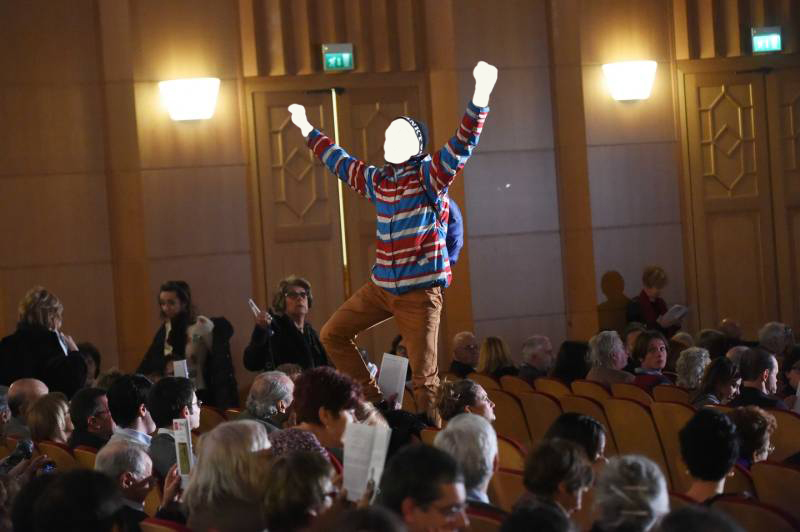
Davide Tidoni
No No Nono No NO!
una composizione di Mattin per Luigi Nono
30/1/2015 - 30/1/2015
Teatro Manzoni Bologna
Venerdi 30 gennaio 2015 Xing e Fondazione Teatro Comunale di Bologna presentano l’evento unico No No Nono No NO! al Teatro Manzoni (Via De’ Monari 1/2 - Bologna) in apertura della serata della stagione sinfonica 2015.
No No Nono No NO! è il titolo della nuova composizione del musicista e compositore basco Mattin, commissionata da Xing in occasione del progetto RESISTENZA ILLUMINATA. Omaggio a Luigi Nono nel Settantesimo anniversario della Resistenza e della guerra di Liberazione 1945 – 2015. Cinque persone di diversa età ed estrazione prestano la propria voce per un'azione lanciata dalla platea del Teatro Manzoni, come preludio al programma della serata. L'opera di Luigi Nono, il suo impegno estetico e politico, forniscono lo spunto per questa nuova composizione di Mattin, un polemos corale che assembla frammenti testuali a discorsivi, brevi asserzioni e statements, che hanno caratterizzato la cultura del novecento nel dibattito tra realismo e formalismo, infuriando negli anni '30 nella discussione tra Ernst Block, Georg Lukàcs, Bertolt Brecht, Walter Benjamin e Theodor Adorno. Buona parte dell'esplorazione sonora di Mattin è radicata nel contrasto sonoro (rumore/silenzio) e contestuale (attenzione/distrazione), e trova in questa evocazione proattiva un impiego ambiguo delle nozioni di alienazione/straniamento, polarismo che ha contraddistinto quel dibattito lasciando una lunga scia problematica che, anche attraverso l'opera di Nono, si prolunga mal dissimulata fino ai nostri giorni.
con Gianluca Albertazzi, Isabella Mongelli, Filippo Pagotto, Andrea Ruggeri, Davide Tidoni
una commissione di Xing
all'interno di RESISTENZA ILLUMINATA. Omaggio a Luigi Nono nel Settantesimo anniversario della Resistenza e della guerra di Liberazione 1945 – 2015
Xing info: 051.331099 info@xing.it
Fondazione Teatro Comunale di Bologna biglietteria + info: 051.529019 boxoffice@comunalebologna.it
Biglietti:
presentando alla biglietteria una stampa del voucher scaricabile da qui si riceverà gratuitamente la card annuale “Resistenza Illuminata” valida per un ingresso ridotto alla serata di 10 euro, e sconti per gli altri appuntamenti del cartellone dedicato a Nono.
On 30th January, Xing and Fondazione Teatro Comunale di Bologna present the event No No Nono No NO! at Teatro Manzoni in Bologna.
No No Nono No NO! is the title of the new composition of the basque musician and composer Mattin, commissioned by Xing on the occasion of the project RESISTENZA ILLUMINATA - A tribute to Luigi Nono on the 70th anniversary of the Resistance and Liberation war 1945 - 2015,
a one-year long program coordinated by Bologna's Opera House, involving
many organizations in town. Five people of different ages and
backgrounds give their voices for an action launched among the audience
of the Teatro Manzoni, as a prelude to the evening's program. The work of the italian composer Luigi Nono, his aesthetic and political commitment, provide the inspiration for this new composition by Mattin, a choral ‘polemos'
that assembles fragments of textual discourse and short statements that
characterized the culture of the twentieth century in the debate
between realism and formalism. Specifically Mattin will be looking at the notion of alienation/strangement in the work of Nono.
Spain is Pain (playground magazine)
Como
tercer vértice de ese triángulo de ejemplaridades de la repercusión que
algunos de nuestros músicos experimentales vienen teniendo por ahí
fuera podríamos citar al vasco nómada Mattin,
agente discordante interesado en el software libre, el anti-copyright,
la improvisación y el ruido (o el contraste silencio/ruido) como vías
de experiencia y reflexión a menudo dirigidas a cuestionar las
convenciones que vienen rigiendo la práctica de la improvisación como
género, y a explorar los límites de la resistencia (física y psíquica)
de su público a través de prácticas que podríamos tachar de
confrontacionales y alienantes. Nada mejor que el artículo central que le dedicaba hace dos meses la revista The Wire para entrar en contacto con el curioso mundo de este punk airado y leído.

Seguirle
la pista a la muy irregular discografía de Mattin cuesta, así que el
que se crea interesado en las cosas de este hombre que acuda
directamente al inventario
que él mismo mantiene al día en su web. Para que te hagas una idea,
durante el año pasado Mattin estuvo involucrado en más de una docena de
lanzamientos, un par como colaborador del desaparecido Josetxo Anitua en Josetxo Grieta, hasta tres otras referencias como parte de Billy Bao (publicadas en Afterburn, Parts Unknown y Drone Errant, todos sellos extranjeros), otras dos como mitad -junto a Tim Goldie- de Deflag Haemorrhage/Haien Kontra (dos álbumes para Tochnit Aleph), y más como mano derecha de Philip Best en Consumer Electronics, o en colaboración con gentes como Eddie Prevost, Bruce Russell, Alan Courtis, Malatesta... El pasado febrero, el sello berlinés Rumpsti Pumsti (también tienda de discos consagrada al mundo más experimental) publicaba su último trabajo hasta la fecha, “Distributing Vulnerability To The Affective Classes”, disco que documenta la performance a-musical que Mattin y el japonés Taku Umani ofrecían a mediados del pasado diciembre en la sala Rigoletto de París.

Además de esas grabaciones, en el currículo más o menos reciente de Mattin destaca su papel como coeditor -junto a Anthony Iles- del libro “Noise & Capitalism”, recopilación de ensayos breves -de Eddie Prevost, Ben Watson, Ray Brassier, Nina Power
o el propio Mattin- que exploran el rol de las músicas experimentales
en relación al contexto socioeconómico en el que esas músicas se vienen
produciendo, poniendo un especial interés en investigar los momentos de
emancipación (emancipación de las pautas de conducta determinadas por
un capitalismo que afecta a cada parcela de nuestras vidas) que pueden
derivarse de prácticas como la improvisación y el ruido.
El libro, publicado en formato físico por Arteleku Audiolab, puede descargarse en formato PDF haciendo un click aquí. Merece la pena leérselo. Y si un día descubres que Mattin toca cerca de tu casa, acude.
Servidor le ha visto algo así como una decena de veces, y el vasco
siempre ha ofrecido un “concierto” distinto. Eso sí, avisamos de que en
sus performances a menudo se le otorga más valor a la idea, al concepto
que se explora, que a la propia música.
From Closer to Near Blog
Algo
curioso ha sucedido durante los últimos meses en la revista The Wire.
Todo comienza con un anuncio que usa una imagen bastante turgente de
una mujer japonesa. Durante los siguientes números se reciben cartas de
protesta sobre como una revista “intelectual” como esta puede rebajarse
por cuestiones económicas a publicar este tipo de imágenes que degradan
a la mujer. Como es obvio, todas ellas escritas por hombres. La revista
sorprende con su respuesta: la sesión fotográfica para una entrevista a
Mattin recrea la pose y el vestuario. Es decir, mostrar a las claras
como un público tan supuestamente libre, inteligente y crítico entra al
trapo de cualquier provocación colocada como trampa. El anuncio incluía
el nombre de la modelo (Saori Hara) y cualquier búsqueda en Google
arrojaría la evidencia de que es una actriz porno. No nos dirá nada
sobre la imagen y representación de la mujer, pero si como se disponen
las cosas para generar esa respuesta en las mentes "bienpensantes" y
estar hablando con dicha excusa sobre un producto.
Carlos Manuel Estefanía.
Noche de Ruidos en el Cervantes de Estocolmo
By cmea62
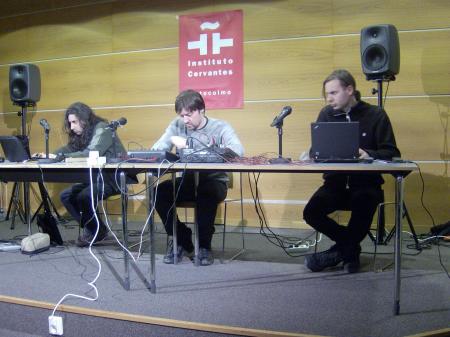
11 de Enero de 2010.Instituto Cervantes de Estocolmo, Charla-Concierto: "Ruido y Capitalismo". Foto: Germán Díaz Guerra
Comentando el coloquio-concierto Ruido y Capitalismo
Llegue in tanto temprano al Cervantes, con la idea de “hacer tiempo
en su biblioteca” eran las 17: horas y 45 minutos, el concierto charla
comenzaría oficialmente a las 18:30. Desafortunadamente la biblioteca
ya estaba cerrada, por reparaciones, con una ciudad congelada no era
cosa de volver a salir, así que me acomodé en el vestíbulo a leer y
releer los libros que quería devolver ese día., a dar uso de la páginas
que por poco interés o premura me habría saltado.
Fue la oportunidad de fijarme en el publico asistente al evento,
conformado entre otros personajes por dos tres maestros, dos chilenas,
una de las cuales conocía de antaño y un colombiano. Este último
charlaba sobre la aplicación que hace entre sus alumnos y sin la
complacencia de sus colegas suecos de la pedagogía de la liberación, de
Paulo Freire, comunicándome sin quererlo su orientación hacia esa
izquierda que siempre que solo aplica la liberación en un sentido,
nunca contra el poder que ejerce sobre sus miembros en nombre del
anticapitalismo el partido.
Por fin se inició el evento: sobre el estrado Alan Courtis, junto a
otro “artista” de apellido sueco hacía su parte en la obra, un ruido
ensordecedor.
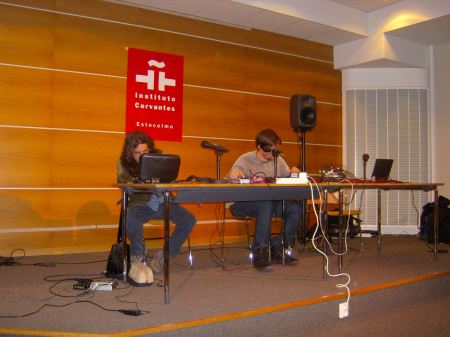
Alan Courtis, derecha. Foto: Germá Díaz Guerra
mientras que Mattin con
un micrófono, daba vueltas por el salón improvisando un discurso en el
que alternaba una especie de descripción del estado de los
espectadores, con gritos desgarradores, que no vendrían al caso.
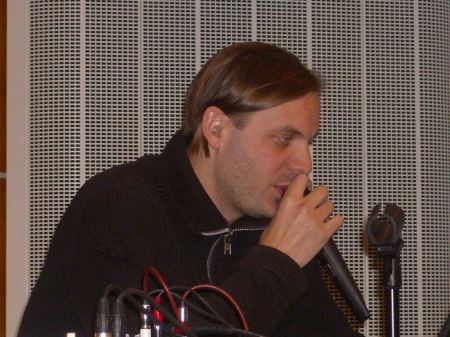
Mattin. Foto: Germán Díaz Guerra
No pasaron muchos minutos sin que mis colegas chilenas se retiraran,
no sin antes preguntarme una de ellas, la que ya conocía, si me
quedaría para escuchar aquel “bodrio”.
Sin duda alguna los “músicos” habían logrado el primer objetivo de
todo artista de vanguardia que se precie, provocar a sus, o a alguno de
sus, espectadores.
Terminada esa sección la directora del Cervantes, Zoe Alameda
presentó la actividad como la apertura del ciclo “Intensidades”, del
que participaran artistas e intelectuales. Por cierto en la página del
Cervantes se anuncia el ciclo con una palabra no precisamente española: Intensities,
lo cual me parece una conseción innecesaria a la lengua inglesa, algo
cada vez más común en los programas culturales, sobretodo televisivos,
que se generan en nuestra “Madre Patria”.
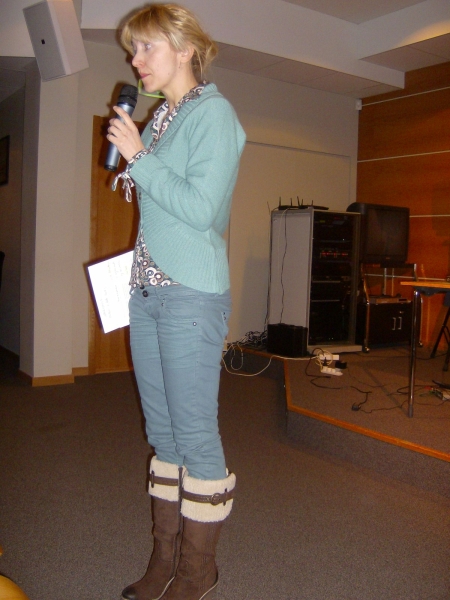
Irene
Zoe Alameda, Directora del Cervantes presenta el ciclo que se inicia
con la actividad de esta noche. Foto: Germán Díaz Guerra
A continuación se inició un dialogo entre Courtis y Mattin, sobre la
relación entre el arte y el capitalismo, sobre la posibilidad de
superar el capitalismo con los medios del arte. Un diálogo en el que se
le daba participación al publico, oportunidad que aprovechó el profesor
colombiano para exponer su rechazo inicial al evento y su curiosidad
por la manera en que el capitalismo sería enfrentado por los artistas.
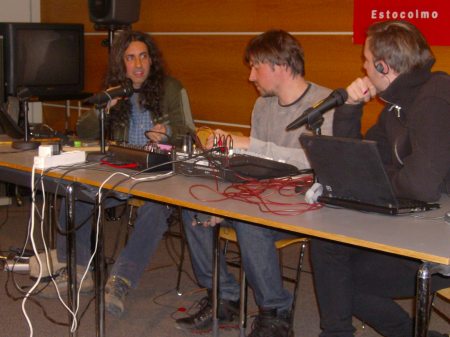
Courtis y Mattin debaten sobre creación artística y capitalismo. Foto. Germán Díaz Guerra
Courtis y Mattin comenzaron a responderle el hombre se levantó y se
fue, por lo visto disgustado con un enfoque que se apartaba del típico
manual leninista, perdiéndose el final, bastante ortodoxo que daba
Mattin, el de que sería por una acción colectiva.
Continuó la charla, por momentos incoherente y casi una polémica
entre Courtis y Mattin, cuando el primero aceptaba la existencia de una
dimensión humana de la creación que no se sometía al capitalismo,
mientras que el otro aseguraba, o daba la impresión de asegurarlo,
seguramente corregirá esta impresión, de que el sistema lo perneaba
todo, señalando como ejemplo que ellos recibía dinero por lo que
estaban haciendo y que los asistentes, para poder estar presentes y
disponer de ese tiempo también deberían haber creado previamente
valores, bajo la normativa del dinero..
Por un momento la indefinición del capitalismo pareció centrarse en
el uso del dinero, y en este sentido me pareció muy acertada la
intervención de la directora como una asistente más , explicando,
además de la tendencia que todos tenemos a maximizar nuestras
ganancias, la importante del dinero como instrumento, como una símbolo
o convención que ayuda en el proceso del intercambio de valores, y por
supuesto un estadío superior al trueque, indicando que el mal no está
en el dinero en si, sino en su conversión en un fin.
Por mi parte con el concierto charla se reavivaba en mi la
preocupación que despiertan estos artistas que en busca de rupturas
hacen lo mismo, que he visto hacer en Cuba, con todo y el totalitarismo
imperante hace décadas, que a su vez era lo mismo que hacían las
primeras vanguardias, al fines del siglo XIX y principios del XX.
Así se los hice notar a los creadores, cuestionando ruido que
hacían, no tanto ruido físico , como ruido en el sistema capitalista,
concretamente en sus códigos de creación cultural, aludiendo como
ejemplo a las viejísimas grabaciones de Juan Blanco, el introductor de
la música electroacústica en Cuba que, yo, que era mas joven que ellos,
hoy les doblaría la edad, había escuchado en un país de la periferia
como era mi isla, subrayando que lo que estaba presenciando no iba mas
allá de los que se hacía a mediados del siglo pasado y talvez antes.

Juan Blanco (1919-2008) introductor en Cuba de la música electroacústica.
Alan Courtis se defendió diciendo que ellos no hacían música
electroacústica, ni tampoco habían dicho que estuvieran haciendo algo
nuevo, que ese tipo de música se hacía desde 1910.
Por su parte Mattin criticó a quienes sin haber leído, Noise & Capitalism, su libro , por cierto publicado en la lengua que algunos llaman del imperialismo, lo criticaban.
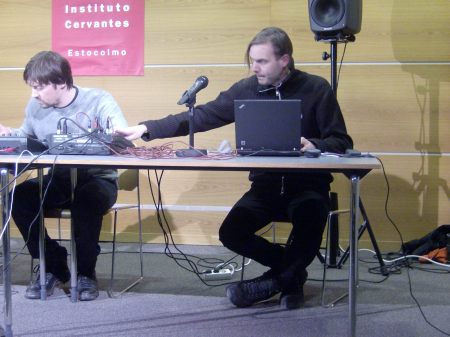
Mattin, derecha, "haciendo ruido". Foto: Germán Díaz
No quise alargar mas el evento con una polémica personal con los
artistas, aunque declaro en mi defensa que nunca declaré que ellos
dijeran que lo que hacían era nuevo, ni tampoco me refería a su libro,
sino concretamente a un espectáculo, no exento de carga ideológica, en
esta caso anticapitalista, que paradójicamente a quienes había
espantado era, presumiblemente, a los más anticapitalistas de los
asistentes, los dos tres maestros sudamericanos.
Debo concederles que no se trataba de música electroacústica, si por
ella se entiende obras compuestas por sonidos pregrabados o
sintetizados, quizás en propiedad habría que hablar, dado el uso de
computadoras al margen de los instrumentos rústicos que se empleaban,
desde un arco hasta tiras de pegar, de música electrónica en su genero
experimental, que de alguna manera sigue la huella del creador de la
música concreta Pierre Henri Marie Schaeffer, sólo que si aquel grababa
previamente musicales y ruidos concretos, en este caso la producción
del sonido, se hacía e improvisaba en vivo, ante el espectador.
Incorporándose a ello desde el dialogo entre los artistas hasta la voz
de la propia traductora que vertía sus palabras al sueco.
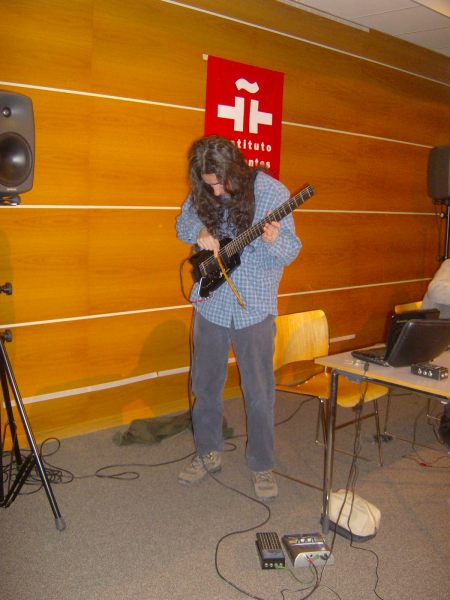
Alan Courtis. Foto: Germán Díaz Guerra
No se le puede negar merito a estos creadores, no importa lo
incompresible, grotesco u ofensivo que resulte para muchos espectadores
lo que hacen, es verdad que no son gestores de un género, sin embargo,
me dan la impresión de que con mucha seriedad intentan reordenar los
elementos de lo que hace hasta darle el sello personal que todo artista
busca.
Otra cosa sería pretender subvertir el capitalismo con este medio, subtexto de lo que vimos este día en el Cervantes.
Sin lugar a dudas entre arte y capitalismo se da una relación muy
parecida a la que existen entre; “rex cogitans” y “rex extensa” la
pensamiento y materia, desde la percepción cartesiana, apenas se
encuentran. Aunque cuando lo hacen es para beneficio de la segunda , en
este caso del mercado que sabe como sacarle un máximo partido al arte
auténtico y aunque también a lo que no lo es.
De ahí que el artista, que realmente lo es no pueda con su obra
subvertir nada, mientras que el mercado sabrá sacarle partido al mismo
con arte e instrumentalización política, lo que ocurre entre nosotros y
la muerte, según Epicuro, que no nos concierne pues, “mientras
existimos , la muerte no está presente”, en esto le doy la razón a mi
colega Germán Díaz, presente en el evento, quien a la salida me
comentaba que cuando el arte se mete a hacer política deja de ser arte.
Por lo demás no dejo de felicitar a la dirección del Cervantes por
haber revitalizado la fría y oscura noche de Estocolmo con el ruido de
unos artistas vocación creativa y provocadora, merece nuestro aplauso.
………………………
Pinche a continuación para escuchar una entrevista hecha a Mattin
con motivo de la publicación del libro “Ruido y capitalismo”: Ars Sonora – 02 enero 2010
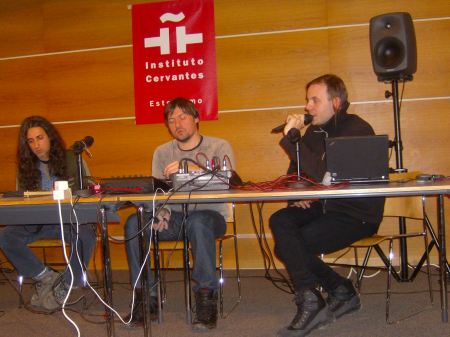
Instituto Cervantes de Estocolmo: Coloquio-concierto "Ruido y Capitalismo". Foto Germán Díaz Guerra
I hate music
by Julien Skrobek
There are two wooden chairs on the stage, each of them bathed in the pool of light of a white spot.
Mattin
and Taku sit down and quietly look at the audience. As always with
those two, no one knows what is coming. Their position resembles the
one evoked on the
Attention
record, a favorite of mine. However, Taku is not holding a guitar, and
as a matter of fact, there are no instruments on the stage. I think of
what
Mattin told me earlier about
making 'simple things.' I must admit what they did tonight may be
simple in its means, but it's surely quite complex in its implications.
After a while, they start sobbing. It is not clear at first if
they are crying or laughing, so the audience sort of takes the easy way
out and assumes they must be laughing. They take it lightly and some
people are laughing too. However, the sobbing gets more intense, and
thay start making the most heart-wrenching crying. I remember thinking
they must be reminiscing over sad memories until the tears come to
their eyes. The audience starts to feels uneasy. You can really feel
it. All the laughing stops. You wouldn't laugh at someone crying in
front of you, would you ? What would you do ? To come on stage and
comfort them or ask them what is wrong would probaly interrupt the
performance. How would they take it ? We will never know, because
nobody dared to ask them anything. After all, this is a performance
that we are watching. Two men are focusing on their inner darkness
enough to make themselves cry in front of an audience, and this
audience is paying for it.
The performance works on many levels. Sonically, the voices are no different from instruments.
Mattin and Taku's voices are quite different, so I am reminded of two reed players with different tones.
Mattin
cries like a baby, slowly rising waves, while Taku's body is completely
shaken by sobbing, making a more percussive sound in a way. It took me
a while to realize that this actually worked as music. My neighbor told
me this was better than Phil Minton as far as abstract vocal
performance was concerned. Now I don't know about Phil Minton (I sure
hate that Toot record though) but this allowed me to take this in as
music and realize it was some kind of free music after all. I have read
and heard so many people about how Ayler or Coltrane could make their
saxophones cry, I guess I was ready to hear some music in this crying
tonight.
The effort of concentration is visible upon their
faces, until another peal of crying can be brought up. You can't escape
the fact that those men are focusing on crying, and this puts the whole
idea of sadness at the forefront in the venue.
Mattin
has tears in his eyes, but I think this is mostly because of the white
spot directed at him. Maybe the absence of real abundant tears shows
the artificiality of the performance to some extent, but it doesn't
undermine the fact that the sound comes from the feelings they can
bring up and arouse within the audience. To some extent, the sound of
crying is severed from the act. I'm sure they are not so sad, or at
least not for the same reasons and not to the point of crying so much,
but the sounds they produce communicates a feeling even though it is
decontextualized. I am very impressed by the amount of ideas they
brought up with, well, nothing but ideas.
This lasts for an
hour. Some people have left, others seem devastated by sadness. There
is even one guy who is crying himself. At the back of the venue, a
couple of girls are giggling nervously, and I can't help but think that
they are trying to get rid of this strange feeling they got.
What
would you do if you saw somebody crying in the metro ? Either you'd
comfort them, or you'd ignore them. Here this is an impossible
alternative. No one will walk on stage, and everybody paid to see this,
making for a very uncomfortable but questioning situation.
After an hour, I start clapping (as
Mattin and Taku had instructed me to do) soon followed by the rest of the audience. The end. Later on at the bar I can hear
Mattin
explaining to someone that he had asked me to clap after an hour,
because the guy thought it was so rude of me to interrupt this crying !
Very very strong performance.
I hate music
by Julien Skrobek
Billy Bao is playing at a venue called Les Instants Chavirés in the Montreuil, in the suburbs of Paris.
In the absence of Xabier Erkizia, Billy Bao is playing as duo tonight, between Mattin (alectric guitar and computer) and Alberto Lopez (drums).
The venue is in complete darkness. The only sources of light are Mattin's laptop's screen and the leds from amplifiers.
The
players are not on stage but in the room itself, on ground level with
the audience. However, most people unconsciously decide to stand on the
stairs or around the bar, which are all elevated places. As a result,
the band is lower than the audience and most people are watching from
above...
Most people are wearing earplugs because they believe Billy Bao
is going to play very loud. Some are hiding behind the pillars of the
room because they have read some reviews of previous performances by
Mattin and don't want to be asked to take part (riding a bike, asking
questions, being thrown objects at...)
The music begins with
cymbal crashes and guitar explosions. There are variable amounts of
silences between those explosions which forbids me to construct them as
a rock'n'roll start, although I clearly recognize the elements.
Those
crashes are followed by a longer silence. After a while, Mattin
crouches to reach his computer on the floor and starts working on a
sound. Slowly, frequencies emerge from the amplifier. I think the
guitar is fed through the computer into the amps and the computer
serves to filter the sound, but I'm not sure.
This part is quite
beautiful, reminiscent of what can be heard on White Noise with Radu
Malfatti from the part of Mattin. Very high and very low frequencies
emerge from the silence, never becoming clearly perceptible without a
time of adaptation.
After a new burst of sound from the guitar
and the drums, the stage lights up and Philémon, musician and crew
member of the venue, appears holding a piece of paper. Mattin switches
off the amplifier and starts playing a very basic rock'n'roll riff
while Alberto provides a minimal drum accompaniment with short rolling
toms and snare hits.
The text read on stage is Billy Bao's
artist contract. What, Who, Why, Where, How much, we get to hear every
detail of the financial transaction between the contractors. The
contrast between the music being played, quite straight although hushed
rock'n'roll, and the words works fine, because the music, in a mostly
traditional form, is clearly an accompaniment to the contract, and not
the other way round. So does it mean that this kind of playing has
become over the years an accessory to contracts and consumation ?
When Philémon has finished reading the contract, Mattin and Ernesto immediately launch a long noise improvisation.
Ernesto
is playing very fast, it is exhausting just to watch him ! At the
moment I tell myself he is a drummer with much energy and focus. Mattin
is playing the guitar and it is definetly filtered throught he computer
as his sound is incredible. The strumming is completely unperceptible
and all the sounds bleed into each other to form a mass of noise. What
is striking is that the sound is never harsh nor agressive, just a loud
beautiful noise. Dense fabric, rich texture, whatever: it's good noise.
This part lasts longer than the others so it tends to form a piece of
its own, with Ernesto varying his approach ont he drums, never setting
into a fully rythmic mode, and Mattin slowly altering the texture of
the mass of sound he has generated.
Many people in the audience
quit the earplugs, realizing it's not really that loud. It's noise
music but it doesn't attack you or your ears, it just works better
loud. Mattin moves around a lot, changes the position of the amps,
listens to the sound coming out of them, works on the equalization: all
technical decisions that keep the music moving. The music ends when the
two have reached a peak in fulfilling the sound spectrum. Then they
start packing. It is not clear for a moment if it's over, but it is
when someone shouts « lights ».
The audience moves to the bar or
outside for a smoke. Not much political or conceptual discussions, what
I seem to be hearing the most is that it was fucking good noise.
Comment at Troniks Noise Forum on Mattin at No Fun 2009
Also of note I think Mattin really ruled, as he did with his intense
show with Wiese here in NYC a last year. Apart from the performative
presence of the musician's body, the other thing totally lost in new
noise is true Confrontation a la early Whitehouse, Intrinsic Action,
and most recently and intensely the terrorizing of Slogun - all artists
who implicate both the crowd and themselves(in quite different ways
obviously) in the lyrical aggressing which was the essence of true
punk, dada, etc. - and I see Mattin working all alone(at least from
what I know in the US right now) very much in this tradition
successfully in an entirely opposite, new way. He had that entire room
of wastoid noise freeks under his thumb silenced 100% for 15-20 mins. -
you could hear every whisper and can't hesitate comparing his turnin
the lights on to no-nonsense TG live as happened here last month with
their return tour. Also really felt his sideways positioning in
relationship to/and addressing where he performed at his laptop just
seconds before, and thus suggesting confusedly either an analyst(or
perhaps himself-as-analyst or 'consciousness-itself' at work in his own
head in the moment) OR the crowd's 'thought' takin the piss outa his
OWN set was a really interesting and a very intelligent gesture, and
sure a lot of you dudes admit it or not felt many of the criticisms he
had but have never had the balls to spit it out...whether its John
Slogun or Mattin, a little 'Fuck-You' is definitely a healthy killer
thing, Bravo!
from NeverTellMeTheOdds.org
messageboard regarding Mattin show in Pittsburgh:
stabbedintheface posted this on Feb 14th, 2009 at 11:40:07 pm
SERIOUSLY BEST SHOW. THIS IS IN THE TOP 10 SHOWS ALREADY. Anyone who
didnt come fucking missed out. Ovens says "better than monster trucks"
I dont even want to write down everything that happened yet, but this
was a breath of fresh air and fucking true FUN AND POWER
Wildcat! posted this on Feb 14th, 2009 at 11:58:15 pm
Mattin's set was unreal. i didn't know even know what was happening
most of the time. scream therapy + choose your own adventure = noise
orgy.
stabbedintheface posted this on Feb 14th, 2009 at 11:59:54 pm
PILES OF FUCKING SHIT BEING CONSTRUCTED
stabbedintheface posted this on Feb 15th, 2009 at 12:00:34 am
SEGWAY OFFICER MATTIN COLLABORATION
scratch that
MATTIN/EVERYONE COLLABORATION
esoteric posted this on Feb 15th, 2009 at 03:48:34 am
this was fucking amazing. who was taping it? that better get uploaded
to something.
chuckleberry posted this on Feb 15th, 2009 at 04:17:35 am
So weird. So awesome. So confusing.
Best MJ set I've seen in awhile.
Good job Ed.
PUNKNEVERDIE!!! posted this on Feb 15th, 2009 at 06:56:11 am
the set by the food truck outside was pretty tight
Ken Kaminski posted this on Feb 15th, 2009 at 07:05:02 am
I bought a fudgsicle.
stabbedintheface posted this on Feb 15th, 2009 at 10:40:50 am
i went to a noise show and since all of the musical boundaries had
been broken, i assumed all social boundaries disappeared too so i
murdered someone and everyone cheered
hapahaole posted this on Feb 15th, 2009 at 11:00:41 am
great show! imprax!
ZOMBIEw0lfG0D posted this on Feb 15th, 2009 at 01:26:21 pm
so fucking good
Johnsen and Tusk killed it
Mattin's "colab" was the most insane thing i have seen since i saw
dressed in full half truth gear
jmadd... posted this on Feb 15th, 2009 at 01:39:29 pm
so how was this?
jmadd... posted this on Feb 15th, 2009 at 01:39:45 pm
did mattin do his screamo act?
adam_macgregor posted this on Feb 15th, 2009 at 01:48:26 pm
This was fantastic, indeed. Ups to Reeves for his tag-team performance.
I recorded some of the show - assuming the performers are cool with
it, I would share.
Mattin is a real nice guy too.
Vin posted this on Feb 15th, 2009 at 02:17:04 pm
Bummed I missed this to go see the Slicks instead, but sounds pretty
interesting and fun.
Ryan Emmett posted this on Feb 15th, 2009 at 02:47:15 pm
Segway Officer got to applause.
Easily one of my top 20 shows of all time. What I felt at first could
be forced, predictable and maybe even pretentious soon turned into the
exact opposite of those things. Putting my cell phone on the tower and
not really knowing if it was going to be safe or not felt awesome.
Although... in the end I gathered it back up. I'm a slave to the man
:-(
stabbedintheface posted this on Feb 15th, 2009 at 02:53:38 pm
while you so called "punks" were sitting on your dicks you missed the
punkest thing that has happened or will happen in all of 2009.
carrier posted this on Feb 15th, 2009 at 02:55:12 pm
straight up ruled
stabbedintheface posted this on Feb 15th, 2009 at 03:27:54 pm
Highlights:
-Mattin saying that the set up was too conventional and wanted to
bring the speakers downstairs. Chuckleberry and I immediately grabbed
the speakers, unplugged them and brought them into the basement.
Mattin asked we bring them back (which at first we said no) so we
could bring it down while the noise was still going.
-bringing the whole soundsystem, laptop and connected cables, while
still blaring noise, down into the basement
-Mattin screaming into his laptop, the mixer, garbage cans, etc
-Mattin puts the laptop in Reeves hands and they both are screaming
into the laptop together (in the basment)
-Chuckleberry and others holding the speakers and swinging them around
so the sound was constantly changing
-covering everything in a tarp, stacking tables, chairs, ladders, cups
and garbage cans into giant garbage pyramids, while Reeves/Segway
officer continued to hold the laptop (in the basement)
-Speakers in garbage cans
-putting garbage cans on top of speakers upside down, and then putting
cups, change, keys, and finally beer on the garbage cans so it all
vibrated on top of it.
-Mattin still screaming
-Slow clap for Reeves performance at the end. Everyone chillin in the
basement
-Hugging Mattin
This is exactly what I want in a noise show.
intense_andy posted this on Feb 15th, 2009 at 03:34:55 pm
stabbedintheface posted this on Feb 15th, 2009 at 02:53:38 pm
while you so called "punks" were sitting on your dicks you missed the
punkest thing that has happened or will happen in all of 2009.
LOL. has anyone pierced their ear before?
stabbedintheface posted this on Feb 15th, 2009 at 03:37:11 pm
that will be the second punkest theng
dan letson posted this on Feb 15th, 2009 at 04:30:26 pm
damn. this sounds cock-esp level. missin' u ~.
chuckleberry posted this on Feb 15th, 2009 at 05:02:10 pm
another thing that should be mentioned is that whatever program mattin
had running on his computer was called "almost whitehouse"
ZOMBIEw0lfG0D posted this on Feb 15th, 2009 at 06:34:06 pm
hahahahahahahaaaa
carrier posted this on Feb 15th, 2009 at 06:41:21 pm
it was supercollider, right?
MongeziFezza posted this on Feb 15th, 2009 at 07:17:42 pm
yo carrier, i would like u to have one of my silk-screen prints if u
would like one...in appreciation for playing the show.
MongeziFezza posted this on Feb 15th, 2009 at 07:18:59 pm
oh and thanks to everyone for coming. this was a blast.
stabbedintheface posted this on Feb 15th, 2009 at 07:24:31 pm
thanks ed!
chuckleberry posted this on Feb 15th, 2009 at 07:28:01 pm
it could have been supercollider. it just looked like C to me, ted
might know. or reeves.
carrier posted this on Feb 15th, 2009 at 07:32:06 pm
thanks, ed. i'd love that.
i'm pretty sure i saw the words supercollider at the top of the screen.
chuckleberry posted this on Feb 15th, 2009 at 07:36:19 pm
a google search for "mattin supercollider" brings up him posting on an
SC forum, so i guess that settles it.
Ken Kaminski posted this on Feb 15th, 2009 at 08:01:18 pm
Almost Whitehouse? I don't remember the subject of rape coming up even
once. What's the Spanish word for rape?
strangenotes posted this on Feb 15th, 2009 at 10:11:12 pm
yeah, this was so fucking great.
Karin
Schneider & Mattin's performance at Transmission Gallery (Glasgow)
at Melanie Gilligan's show.
26th April 2008
Review by Ben Seymour
As
a participant it struck me as a lot like being on ketamine at a free
rave, but with the difference that at a free rave nobody asks you to
vocalise into a microphone your impression of taking a painful shit.
as a whole it was like a free improv version of tino sehgal, with a
dantean crowd of strangers and acquaintances circling or vegetating
in the empty white space of the gallery while performing reichian
'loops' of activity; some transient and free/doomed to observe while
orbiting (like me) others slumped at the side of the gallery gazing
into mirrors and mouthing 'i am so wonderful' to themselves, and a
host of variations on futility including counting to 600, climbing up
and down a ladder and laughing unnervingly at other
participants/victims of this incrementally developing system as they
passed by. each participant was let into the gallery one at a time
from the street, with no foreknowledge of what would ensue (hence the
feeling of having been slipped an unknown drug) and, after wandering
disoriented through the developing human flora and fauna for a few
terrifying/fascinating moments, being lead into a curtained backroom
where Karin and Mattin would tersely assign them a task to perform.
once
released back into the tank, the visitor/participant became
actor/voyeur, some immobilised flat on their backs, others, like
myself, having to perform more obviously to the rest of the zoo.
Someone was shouting out at regular intervals 'Stop talking!' though
it was unclear if this was a response to any particular act of
communication, while a woman at a microphone was making odd 'huh'-ing
noises (I found out later that she was supposed to be evoking some
kind of erotic moan or groan, perhaps a counterpoint to my anguished
- and over-played - pantomime of excretion.) The feeling was one of
confinement and also of ethical ambivalence - should one play along
or refuse, talk to the other participants or get on with one’s
task? Acquaintances and friends seemed estranged by their roles and
hard to approach, the strangers oddly more intimate and easier to
address than moments before outside on the street. Like a continually
evolving Milgram Experiment, one not only was confronted with one's
willingness to obey commands, and forced to examine the basis for
this, but also, again depending on the role assigned to one, to
overcome embarrassment or scruples about participation and
articulation in such a confined and uncanny space.
Inevitably,
as well as reflections on the paranoia/possibility inherent in this
situation, one considered possibilities of solidarity and exchange
with other prisoners/players; thinking of Melanie's works but also of
my own adventures in late capitalist 'fun' houses such as raves and
clubs one couldn't help the almost de
rigeur
feeling of being in a microcosm of post-fordist immanence, a
continuum of watching and acting in which critical distance and
escape are impossible, solidarity hard to imagine, and the confines
of the system radically indeterminate - ie - what part of the human
'events' unfurling around one as if from a computer code were
scripted, and what part improvised or simply diversions? Was the girl
who had been drifting round in narrow circles in the far left hand
corner now chatting on the phone pretending to be talking to someone
or was this her 'real life' imposing itself onto the queasily magical
space? Was Lisa still 'on script' as she started to rove around the
gallery posing questions and, later, clapping us into clapping the
show over, or was she wildcatting? And, more uncanny, had they
allotted us roles on the basis of their knowedge of our
personalities, or had our roles been arbitrarily assigned, acting
instead as a rorschach-like prop prompting us to confront the
habitual attitudes and behaviours which constituted our identitities?
I
was struck by how much I maintained my interest in - and hence
obedience to - the game by analysing it, my passivity while orbiting
and 'taking in' the event (of which I was of course one component,
like a moon in an orrery) making continued repetition of the assigned
role endurable. Critique as the highest form of integration.
The
proximity of 'normal' behaviour and assigned 'routines' was one
immediate revelation, intensifying the performance's power as a
discloser of convention and role play. Having determined that there
were no more new players coming onto the 'stage' of the gallery
through the curtain from the street outside, I was discussing with a
friend whether we should make a break for it and if indeed the
performance’s architects would ever call a halt to it. (It had been
unfolding for an hour and a half at this point and I was, having been
inside for 40 minutes, starting to feel weary of my Dantean
circulation). Ambiguity was so deep that when one of the former door
persons called out 'enough' or words to that effect I felt that this
too should be treated as a scripted speech and subject to assessment.
It was simultaneously scripted and sincere, yet another moment in the
game and a statement which, if followed, would at once confirm the
hold of and dissolve the game. Did one want to stop on these terms?
And would it be right, given the contract between performers and
scripters, to call it off or make an escape? A friend of mine had
already run out screaming 'I can't take anymore' but it seemed stagey
to me.
I
reckoned I knew Mattin and Karin well enough that they wouldn't
script in a determinate ending, and I later found out that the
performer who called 'enough' had been left absolute discretion as to
when to do so. As it transpired we were all spared a long night in an
abstracted, sensory deprivation version of the Big Brother cells, but
it would have been intriguing to see how we guinea pigs would have
responded to an even more drawn out incarceration.
As
the performance collapsed into applause, a little predictable and yet
appropriately stagey in its own right, I remembered the closing scene
of David Fincher's The
Game,
as we stood around discussing with strangers and (other)
acquaintances our roles and complementing each other on our
performances ('you were supposed to be taking a shit? i would never
have guessed!'; 'you were brilliant at “stop talking”, a real
natural, etc). Throughout the piece, or at least for some time before
I entered the room, the artist who commissioned it, Melanie, sat in
the centre of the room typing into a laptop. Looking at the screen
one discovered it was not covered in rows and rows of 'All work and
no play makes Jack a dull boy', like the type written screeds of
Nicholson's frustrated writer in The
Shining,
but rather contained a detailed real time transcription of all the
events transpiring in the room - and, contra to my
impression/projection during the performance (another rorschach
moment of self-revelation through misrecognition) Melanie had not
known her role in advance anymore than the other players. This had
been her assigned task, and she had carried it out, apparently, quite
sedulously.
I
haven't read it over yet but all participants were given printed out
copies of her screed on completion of the piece and perhaps are now
finding out how, from a central - panoptic? – point, the
madhouse/playroom/prison appeared to its passive architect.
The
other devisers of the piece never saw any of it, remaining behind the
black curtains at the back of the gallery, and the whole event was
undocumented but for Melanie's report and the testimony of
participants such as this one.
Kafka's
‘In the Penal Colony’ came to mind often during the performance,
and the only once broken paragraph of Melanie's report resembled not
only The
Shining's
scroll but the flesh of the harrowed convict in that story. But of
course here the machine was activated by its subjects/objects and
their movements were at once page and writing. Like Agambenian
sonderkommando,
the victims were victimisers, perpetuating the game. This thought,
naturally, was hard to shake off as one navigated the city-wide 'art
safari' which the GI festival was pleased to bill itself as - one
more bourgeois bohemian circulating in the enchanted game of art
appreciation/production/criticism on which this city (like thousands
of others) has floated its now seriously stymied chances for
survival.
As
the tramps stumble scabrous along Sauchiehall street and the hordes
of girls (un)dressed as policemen disgorge from stretched limos onto
the teeming beaches of saturday night, the looping implications of
the performance unroll in my head, up to and including the
recognition, as the closing night party hosts thank the corporate
sponsors for their generosity, that this game accurately reflects the
sense of passivity and complicity which already structures 'artistic'
production in the wider open prison.
Not
news, but something made news by this piece - one criterion for a
valid or at least half critical art work in the age of compulsory
participation?
CODA
This
and Melanie's various other performances taken together made my
weekend a bit like going to Gilliganworld, a themepark/forest of
symbols where commodity forms corresponded (with each other, and with
the weird spires and gothic towers and about-to-be-destroyed
privatised ex-council blocks of the surrounding skyline) via the
ventriloquism of actors embedded among doctored Piranesi prints in
Transmission's 4th floor gallery. All the way home on the train a
Volosinovian Scottsman gave vent to his exteriorised interior
monologue (including the phrase or judgement 'ass juice') and the
conductress hurried by declaring aloud to all in the buffet car
'that's the last time I wear these knickers!'
All
around the performance is breaking down into a self-burlesquing
corporate crisis, while performance-relatedly the failed performance
carries on being performed, working by breaking (like a Virgin
railway), while over and over again nothing happens. Now, however, as
the workers strike in Graingemouth for the first time in 50 years,
and the North is hit by a Rock, one can't but wonder how long this
particular form of metastable crisis has to last.
publicado en MRB | AMM

Dínamo - Festival de música exploratoria - Barcelos
Sábado 26 de Julio.
Biblioteca Municipal
Mattin / Taku Unami / Jean-Luc Guionnet
En la segunda noche del festival Dinamo y tras la actuación
de
Anette Krebs, la organización del festival nos manda desalojar
el
auditorio. Pasados unos minutos nos comunican que se podrá ir
entrando
en la sala de “uno en uno” dejando un intervalo de tiempo entre cada.
Yo entro el segundo, la sala está casi a oscuras, solo ilumina
sobre el
escenario una pequeña jardinera roja a los pies de Taku Unami.
Mattin
(que espera tras la puerta) me dice ” Para participar de este
concierto, tienes que caminar en círculos alrededor de Taku”.
Bajo las escaleras y veo un cuerpo estático sentado en la
derecha
del escenario. Comienzo a realizar mi orden y al poco va entrando
más
público: Una chica comienza a tararear una canción en el
fondo del
escenario, otra desde las escaleras ríe intermitentemente,
alguien
aplaude, veo un brazo extendido con una mano cornuda. Taku con el brazo
escayolado por completo comienza a tocar la guitarra de manera muy
rápida, como un intérprete de heavy metal, en los
momentos en los que
descansa una chica tiene la orden de darle un masaje, alguien comienza
a dar unos fuertes golpes contra una puerta al tiempo se escucha un
vómito fingido desde el anfiteatro. Jean Luc Gionett empieza a
tocar
desde el backstage algunas notas con el saxofón y es reclamado a
gritos
por un hombre, un puño alzado desde el escenario, alguien
sacando fotos
desde la silla que debería de ocupar Mattin, donde se encuentra
su
ordenador que es amplificado y desamplificado. Tras un rato de
cumplimiento circular de estas ordenes se escucha “What are you doing?”
no hay réplica. Mas tarde la pregunta fue de nuevo formulada y
tuvo
respuesta “Music!!!”
Pasado un rato algunos que descuidaban sus ordenes, se sentaban en
las butacas y observaban el espectáculo. El organizador el
evento se
coloca de espaldas al escenario y en bucle repite esta frase “This
concert will only finish when everyone agrees, otherwise it will go on”
yo me siento satisfecho del concierto y dejo el escenario, veo como
Mattin lo observa desde el centro del palco. Tras un tiempo la gente
que continua participando decide manifestarse diciendo “i agree”.
Cuando fue de forma unánime el concierto se consideró por
terminado.
De que habíamos formado parte en aquel espacio de tiempo?
Fue rota una rutina, un ritual construido, mediante el uso de uno nuevo
creado para la ocasión. Mientras que el primero forma ya parte
de los
arquetipos sociales que nos ha tocado vivir: esperando todos a que el
concierto comience, permaneciendo atentos a lo que ocurre o
interaccionando con el contexto adecuado para ese espacio y cuando nos
toca, aplaudimos a los intérpretes. El segundo se configura como
revulsivo, observamos que hay una orden, un mandato que podemos o no
acatar, pero solo si lo aceptamos formaremos parte del
espectáculo. Fue
curioso observar como en gran medida cumplíamos nuestro objetivo
de la
manera mas precisa que conocíamos, es posible que
quisiésemos formar
parte de aquello, al fin y al cabo era divertido e interesante, la
gente parecía disfrutar. Formábamos parte de una idea
diferente de
cultura y espectáculo. Una reinterpretación de W.Benjamin
por parte de
Mattin “Una cultura desnuda de aplicaciones prácticas y
destructora de
derecho. Una cultura que no se pueda definir en términos de la
propiedad intelectual, porque es intrínsecamente colectiva. Una
cultura
que constantemente esta destrozando cualquier noción
individualista.
Una cultura trituradora de egos, unos egos que nunca pueden
recomponerse para volver a estar solos”. Y de hecho creo que es
interesante pensar acerca de nuestra noción individualista en
aquellos
momentos. Hay una identidad (en este caso Mattin) que nos da unas
instrucciones, este mandato podemos entenderlo como “dictatorial”,
porque no hemos podido decidir nuestra acción….. al cabo de un
rato
podemos pensar en nuestras libertades individuales mientras que
realizamos nuestra función, nuestras libertades a la hora de
improvisar
sobre esta función… es posible que aquí exista una
analogía con las
libertades de un improvisador. ¿ que margen de acción
libre y directa
tienen los improvisadores? En la actualidad ciertas corrientes dentro
de la improvisación han tenido tiempo para crear una ortodoxia,
una
serie de ataduras formales, que no separan mucho el papel del
espectador girando en círculos, del músico que pierde ese
gran campo de
acción en pro de la caricatura de estilo.
No pretendo entender este espectáculo como definitivo como
“arte
total”, al contrario (citando a Mattin de nuevo) lo quier entender como
una “Praxis sin construir”. Creo que los límites de las
instrucciones
de Mattin no eran absolutas no estaban del todo definidas, mas bien
ciertas reglas internas eran las que nos obligaron a ser cuidadosos con
nuestra función. la reflexión de lo allí sucedido
hace frágil nuestra
comprensión, tiende al debate y a la duda, eso es para mí
lo
maravilloso. El “estar de acuerdo” unánime, conserva la libertad
que
nos permite acabar con el juego cuando nosotros deseamos.
“La industria cultural tiene la tendencia a transformarse en un
conjunto de protocolos y justamente por ello en irrefutable profeta de
lo existente. Entre los escollos de la falsa noticia individualizable y
de la verdad manifiesta la industria cultural se mueve con habilidad
repitiendo el fenómeno tal cual, oponiendo su opacidad al
conocimiento
y erigiendo como ideal el fenómeno mismo en su continuidad
omnipresente”
Max Horkheimer & Theodor Adorno
Dialéctica del Iluminismo
Miguel Prado
Septiembre 08
Anti-Copyright
English:
Dínamo
- Festival de música exploratoria - Barcelos
Saturday the 26th, July.
Municipal Library.
Mattin / Taku Unami / Jean-Luc Guionnet
At Dinamo festival's second night and after a performance by Anette
Krebs, the festival organisation ask us to leave the auditorium. After
some minutes they tell us that we can enter the room "one at a time"
leaving an interval between each. I enter second, the auditorium is
almost dark, only illuminated by a little lamp on the stage right at
Taku Unami's feet. Mattin (who waits after the door) tells me "to
participate in this concert, you have to walk in cirles around Taku".
I go down stairs and I see a static body sitting on the right side of
the stage. I begun to realize my part and after little time more
audience is entering: a girl begins to sing a song at the back of the
stage, another one laughs intermittently from the stairs, somebody clap
his hands, I see an extended arm with a hand making the sign of the
horns. Taku, with his right arm on a sling begins to play his guitar
very fast, like a heavy metal guitarist. When he's resting, a girl has
to give him a massage on the back, somebody begins to knock on a door
while a fake vomit sound is heard from the amphitheater. Jean-Luc
Guionnet begins to play from the backstage with his saxophone and
somebody calls him shouting, a man on stage with his fist raised,
someone is taking pictures of the chair that Mattin should be
occupying; there his laptop is amplified and quietened. After a while
of circular adherence to this orders we hear somebody saying "What are
you doing?" without reply. Later on the question was asked again and it
was answered: "Music!!!".
After a while some people neglected their orders, they sat down on the
stools and observed the spectacle. The event organizer says, turning
his back to the stage, "This concert will only finish when everyone
agrees, otherwise it will go on". I feel satisfied with the concert and
left the stage, I see Mattin observing from the center of the stall
seats. After some time the people that continues to participate decides
to manifest saying "I agree". When it was unanimous the concert was
considered ended.
What was it that we participated on that period of time?
A routine was broken, a ritual constructed through the use of a new one
created for the occasion. While the first is part of the social
archetypes that we have to live: everyone waiting for the concert to
begin, remaining attentive to what is happening or interacting with the
adequate context to that space and when it's our turn, clapping our
hands to the interpreters. The second is configured as a revulsive, we
observe that there is an order, a command that we can obey or not, but
only accepting it we become part of the show. I was curious to see
that, mostly, we fulfilled our objective in the most precise manner
that we knew; it's possible that we wanted to become part of it, after
all it was funny and interesting; the people seem to enjoy themselves.
We were part of a different idea of culture and spectacle. A
reinterpretation of W. Benjamin by Mattin: "A culture naked from
practical utilization and destroyer of law. A culture that can't be
defined in terms of intellectual property, because it's intrinsically
collective. A culture that is constantly tearing apart any
individualistic notion. A culture that tears egos apart, egos that can
never recompose themselves to be alone again"(1). And I think that it's
interesting to think about our individualistic notion in that moments.
There's an identity (in this case Mattin) that gives us some
instructions, that command we can understand as "dictatorial", because
we couldn't decide our action... After a while we can think in our
individual freedoms while we realize our function, our freedoms at the
time of improvising over that function... It's possible that an analogy
with the freedoms of an improviser exists here. What degree of freedom
and directness have the action of the improvisers? Today, certain
currents among improvisation had had time to to create an orthodoxy, a
series of formal constraints, that don't separate much the role of the
spectator walking in circles from the music that loses that great field
of action on the caricature of style.
I don't pretend to understand this spectacle as definitive "total art",
quite the contrary (quoting Mattin again) I want to understand it as a
"unconstituted praxis". I think that the limits of the instructions
that Mattin gave us weren't absolute and totally defined, moreover
certain internal rules were the ones that compelled us to be careful
with our function. The reflection of what happened there makes our
comprehension fragile, tends to debate and doubt; that's the wonderful
thing for me. The unanimous "agree", keeps the freedom that allows us
to finish the game when we want to.
"The cultural industry has the tendency to transform itself in a set of
protocols and because of that in irrefutable prophet of what exists.
Among the reefs of the fake individualizing news and the manifest truth
the cultural industry moves aptly repeating the phenomenon as is,
opposing its opacity to knowledge and erecting as an ideal the own
phenomenon in its omnipresent continuity"
Max Horkheimer & Theodor Adorno
Dialectic of Enlightenment
Miguel Prado
September 08
Anti-Copyright
(1) Mattin - Anti-CCopyright: hacia una cultura desnuda
(http://www.mattin.org/essays/Anti-CCopyright.html, in spanish)
Thanks to Roberto Mallo for the traslation
IMPROJAZZ (FRANCE)
Jean-Luc
Guionnet / Seijiro Murayama / Ray Brassier/Mattin : live at NPAI
Festival, Niort 2 August 2008
Si
je devais désigner le plus grand concert du festival, et
au-delà, ce
serait celui-ci sans aucun doute parce qu’il ont su créer de
l’incompréhensible. On pourrait parler de minimalisme :
Seijiro
Murayama avec une caisse claire amplifiée et un tom basse ;
Jean Luc
Guionnet devant un maigre
dispositif electroacoustique, Mattin debout, silencieux, le visage dans
son laptop ouvert, RB guitare à plat sur les genoux
égrène les cordes au médiator
avec une lourdeur de frappe qui fait de chaque son une rencontre, sans
retour, un choc tragique qui revient sans cesse égal à
lui-même. Le
concert, je l’apprendrai ensuite, est organisé en quatre parties
égales, et chaque musicien joue pendant deux des quatre sans que
les
autres sachent quand. Jean Luc Guionnet reste dans des
grésillements
qui répondent aux coups de Brassier. Seijiro Murayama va de
grattements
de la peau de sa caisse claire avec un sur fil d’acier à des
coups
soudains à pleine puissance, et Mattin pousse trois ou quatre de
ces
hurlements sonorisés par son ordinateur dont il a le secret. Le
dernier, long comme un
cauchemar, impose sa marque au concert. Ray
Brassier, qui n’est pas du tout guitariste mais philosophe, a choisi de
ne pas profiter du micro voix devant lui. La
concentration des protagonistes était totale, à la limite
de la tétanie
pour Brassier. C’était de l’inouï, du pas-formulé,
de l’ouverture sans
tricherie sur ce qui ne s’ouvre pas. Au delà on ne va pas, il y
ont
touché et on a senti le temps bouger.
roughly
translated : This
concert was certainly the more impressive of the whole festival, and
more, because they created something impossible to understand. One
could talk about minimalism : SM with an amplified snare drum and a
bass tom, JLG in front of a basic electroacoustic installation,
Mattin
standing up, silent, his face in his open laptop, RG sitting with
a
guitar in his lap hitting the strings heavily, making each sound a
meeting with no denying, a tragic blow that always comes back,
always the same.
The
concert, as I was informed later, was organized in 4 part and it was
decided that each musician would play during two of those four,
the
others did not know when. JLG keeps cracklings going, answering to
the
blows of RB. SM alternates from scratchings of the snare drum
with a
unique steel string, to sudden and very powerful blows, and Mattin
yells three or for times as only him knows how. His last yell, long as
a nightmare, imposed his mark upon the concert. RB, who is not a
guitarist but a philosopher chose not to use the microphone in front of
his mouth.
The
protagonists were totally concentrated, in the case of RB it
was almost tetany. Here came something unheard,
un-formulated, an
openig (with no cheating or make believe) to what cannot be opened. One
cannot go further, they touched it and we felt the time move.
Noël Tachet
El
iconoclasta y ruidista combo bilbaíno edita sus discos
en USA y lanza
tres vinilos, en siete, diez y doce pulgadas, para seguir
«haciendo Historia»
30.08.08 -

En el Villa de Bilbao dieron fuego al
escenario y les multaron con 150 euros. / MAR SECO
Este grupo atiende como Billy Bao porque así se
llama su
líder, quien informa: «Nos juntamos en Bilbao a finales de
2003. Bilbao
cada vez da mas asco y es mejor hacer algo creativo con tanta
frustración. Bilbao se está muriendo y alguien tiene que
decirlo». No
se queda ahí la cosa. Al ser inquirido sobre si pretenden
molestar al
oyente, replica el portavoz: «Hacemos lo que hacemos y si a
molestar le
llamas tratar de romper con estereotipos, pues tú, como
crítico de
música, demuestras ser otro ejemplo de la conservadora multitud
que hay
en Bilbao». ¡Glups!
Se rumorea que Billy Bao es popular en Japón,
pero no.
«Tenemos repercusión sobre todo en USA. Allí hemos
sacado el EP en S-S
Records y el LP en Parts Unknown porque los sellos lo pidieron. Y
sí,
allí estamos arrasando en la escena. Aquí no nos conoce
ni Dios. No nos
importa. Creemos en lo que hacemos y sabemos que estamos haciendo
Historia». Y publicando prolíficos como conejos.
«Mientras nos sigan
pidiendo discos seguiremos sacándolos», sentencia Billy
Bao. «Hemos
acabado otro LP: 'MAY 08'. Aún más oscuro y bestia. Puro
veneno».
«Asqueroso Getxo sound»
Estos miembros laboran. «Uno da clases en el
conservatorio, otro es repartidor, otro trabaja puliendo metales y otro
en la prostitución». Han pasado por combos tipo Josetxo
Grieta (noise
rock), La Grieta («asqueroso Getxo sound», Billy Bao
dixit),
Ornitorrinkus (poesía), Los Tupendos (rockabilly), La Secta
(garaje)...
Entre sus influencias enumeran a Eskorbuto, Vulpess, Whitehouse,
Stooges, Brainbombs, Fushitsusha, The Flying Luttenbachers o Loty
Negarti, y ante la duda hemos comprobado su existencia, ¿eh?
En tiempos recientes han lanzado tres referencias de
rock ruidoso menos vanguardista de lo que barruntábamos. El
portavoz
las disecciona. El LP 'Dialectics Of Shit' es un «trabajo
concebido
especialmente para el formato LP. Todos los temas duran la perfecta
duración rocanrolera de 3 minutos y muestran a un Billy Bao tan
salido
como cabreado. Riffs clásicos stoogianos se repiten
desesperadamente
hasta convertirse en puto ruido no sin pasar por los Brainbombs.
¡Tu
tocadiscos se ha roto!, te dice constantemente Billy Bao, y si no se ha
roto, ¡te lo voy a joder yo! Después de media hora exacta
del punk más
bestia, primitivo y conceptual te encontrarás con la
sensación de que
tu vida es una mierda».
Nos mola el maxi de 'Fuck Separation'. «En el
contexto
vasco, el título puede parecer provocador. Y sí, es
verdad que a Billy
Bao, como a otros muchos punkis, le da asco el concepto de
nación con
fronteras que delimitan y deciden quién está dentro y
quién fuera. Pero
el punk también tiene sus fronteras y limitaciones. 'Fuck
Separation'
trata de romper el concepto de canción punk como unidad con
principio y
final. Billy Bao se adapta al formato EP con 2 temas de 10 minutos que
se rompen a sí mismos: el que empieza en la cara A acaba en la
cara B,
y viceversa».
Y en el curioso 'Accumulation' «otra vez nos
encontramos
a Billy Bao adaptándose al formato, en este caso al single. 10
temas de
un minuto cada uno comprenden esta acumulación de intensidad y
mala
hostia. Empezando por la minimalista en plan art-punk '1' (una nota,
una palabra, un elemento de batería, un minuto) y acabando en la
free-grindcoriana '10', donde Billy Bao ya no sabe contar y la cosa se
desmadra totalmente. Vamos, que al final de este single lo único
que
quieres es quemarte vivo frente a las autoridades, igual que el rumano
Marian Mirita».
La escena local compite con solidez en
el Villa de Bilbao
Traspasada la mitad de la línea del
Villa de Bilbao, el concurso constata que la escena vasca vive uno de
sus momentos más variados y sólidos. De hecho, la
edición número
veinte, puede sacar pecho gracias a las excelentes propuestas que han
llegado desde territorio local.
La actuación de los bilbainos Billy Bao, más Xabier,
de Bera, supuso
la más controvertida de toda la historia del Villa.
Agitación, dislate,
locura, pérdida racional... Provocación y arte, el cielo
y el infierno.
Diez minutos de caos, punk extremo y ruido-arte. Nadie indiferente,
todos activos.
P. CABEZA | BILBO
Pop
Tronics (France)
Le musicien Mattin dans l’acte 0 "Omen"
(présage) de la performance
Moving Forest, à la Transmediale. © DR
< 03'02'08 >
Transmediale 5/6 : « Moving
Forest », l’opéra invasif
« Every
breath ends up as data », « We will bankrupt your
citadel », « Death is
better than work »... Ces phrases sont trois des 500 slogans qui ont rythmé
la performance « Moving Forest » du 1er/02 (que Poptronics annonçait
dès mardi comme un des temps forts du festival), performance
de 12 heures conçue par les artistes Shu Lea Cheang et Martin Howse,
entourés du collectif international AKA The Castle (une
trentaine de
performers venus d’Europe, des Etats-Unis et d’Australie). Ces slogans
écrits pour l’occasion par Matthew Fuller, artiste et théoricien des
médias, ont constitué le livret de cet opéra en
six actes.
La forêt mouvante du titre, elle vient de la fin
du film culte d’Akira Kurosawa « Le Château de
l’Araignée »,
une transposition du « Macbeth » de Shakespeare
dans le Japon médiéval,
et dont on voyait pendant la performance une version
« mangée par le
code » réalisée par l’artiste Graham Harwood
du collectif Mongrel. Les flèches du film se
retrouvaient également dans le travail de Linda
Dement, deux écrans se faisaient face, avec des
flèches d’un côté et de l’autre du sang.
De cette séquence vient donc la trame de la
trahison et
de l’insurrection qui nourrit la narration de « Moving
Forest » en
phase avec la thématique de cette Transmediale,
« Conspire ». Les
musiciens Mattin, Leif Elggren, Kaffe Matthews, et Joachim
Montessuis,
la plupart accompagnés de chanteurs interprétant les
slogans, ont
occupé chacun à leur tour différents lieux de la
Haus der Kulturen der
Welt, avant que la performance ne prenne corps à
l’extérieur pour
l’acte « Insurrection ». Ont marché sur le
lieu du festival, transformé
pour l’occasion en château à prendre d’assaut,
différents groupes, dont
un portant les fusils-radios en bois de
l’artiste Ricardo Miranda Zuniga. Phill
Niblock, après la prise du
« Château » par les ondes et les marcheurs,
fermait la performance.
Autre interprétation des slogans, de
façon sonore mais non vocale cette fois, celle des quatre
membres du collectif goto10
(Marloes de Valk, Chun Lee, Aymeric Mansoux et Valentina Vuksik) qui
ont constitué un « dictionnaire » de
traitement sonore lors de leur
session de « live-coding », triturant le son et
interagissant avec les
streams.
Malgré les changements de dernière minute
et petits
ratés inhérents à une manifestation si
tentaculaire, « Moving Forest »
était une belle et riche performance, tricotant sons, textes,
images et
codes, offrant plusieurs points d’entrée : narration,
conspiration,
technologie (logiciels codés en temps réel, circuits
imprimés faits
maison et radioFM), activisme (une manifestation était
menée
simultanément par un petit groupe à la prison berlinoise
de Moabit),
slogans déclamés tout au long des actes...
| anne
laforet |
|
 |
Das
Kleine Field Recordings Festival
by Rinus Van Alebeek
18. August, Stralau 68 Berlin Friedrichshain:
Rope
Origami Boe and Origami Tacet,
Michael Peters
Mattin
Starts at 22:30
5 euros
Stralau 68
Alt-Stralau 68
10245 Berlin
link of the place with a map:
http://www.soundimplant.com/stralau/Infos.html
Quiet and well enough for Mattin?
Away
went the table. The people at the bar got louder. Expectation filled
the room. One microphone, a beautifull one that coloured very much with
the silvery nightclubbish curtain behind him. Mattin dressed in black.
He pushed something on the laptop next to him. He put on his dark
sunglasses. His hands rested on his hips. He looked around slowly
moving his head. He didn't play a sound.
A public without Markus
Schwill, our own noise phantom of Neukölln would have started
murmering
perhaps, moving chairs, get up and walk away. But everyone stayed,
because Markus decided to answer the proletarian provocation with an
anarchistic one. What followed was almost half an hour of cabaret with
Markus insulting Mattin and public alike, and even yours sincerely who
has always been so nice to the man in red.
It ended when Markus
went on stage, tapped the microphone and sang a little song, then
stepped aside and invited Mattin to hit him, which was perfectly okay
since he was insured.
Mattin remained moveless. Continued to look from behind his shades,
same impeccable pose.
Markus
was back on stage when the great wave of feedback got him and brought
such a brilliant sound to the room that Markus voice underwent a helium
effect, and was heard to tweek like Mickey Mouse. The feedback rolled
off and on in waves. A performance like the thunder you wait for when
you feel the summer's day has built up to it.
I said to Derek
Holzer that this concert should have taken four hours. His reply was
:"Yeah, but could you listen to Markus for that long?"
Michael, the double bass player thought it was the best noise concert
he had ever seen.
Gerd, a first hour fan of the festival wondered what would have
happened when there hadn't been a Markus.
My guess is that we would have heard it coming.

Antoine Chessex
& Josetxo
Grieta (presenting "Euskal
Semea")
EATING BORDERS TOUR
7, La Centrale Bordeaux
8 + Aida Torres (ex-Lisabo),
Maite Arroitajauregi, Xabier Erkiza,
Inigo
Telletxea, Sala Mogambo
Azkuene, 17 - Trintxerpe, Donostia
Interesante concierto (aunque accidentado) el que bajo el nombre ???
jaialdia
pudimos presenciar en el Mogambo de Trintxerpe. Aunque el cuarteto
bera-eibartarra que en principio abría cartel no pudo estrenarse
por
problemas de última hora, los allí asistentes pudimos
escuchar a
ANTOINE CHESSEX y JOSETXO GRIETA en dos abrumadores sets. Y cuando digo
“escuchar” y “abrumadores”, se debe de entender literalmente, hasta
podría añadir “forzosamente” porque ambas actuaciones
fueron de gran
intensidad y volumen. Hasta demasiado, por ejemplo con Josetxo Grieta
que abrieron noche en esa meca del grind llamada mogambo, que, hay que
decirlo, sigue manteniendo el mismo espiritu que hace diez años,
detalle que hay que agradecer a sus gestores. Volviendo al concierto,
como decía, Josetxo Grieta hicieron un interesante concierto
(nos
tienen bien acostumbrados) equilibrado entre composición a
tiempo real
e improvisación, entre canción y flujo surrealista,
siempre aderezado
con la curiosa performatividad que los caracteriza. Un estar sobre (y
debajo) de escenario que mezcla por una parte esa parte casi teatral
pero siempre tan polémica como confusa (totalmente intencionada)
de
mattin, con la tensión de Josetxo Anitua, que muchas veces
parece
intentar controlarse a sí mismo para no explotar antes o
más de la
cuenta. Sin embargo esa intensidad contenida del escenario pasó
factura
a la actuación que en un alarde de frecuencias extremadamente
agudas
(cortesía de mattin) venció a la capacidad del equipo de
sonido
(tampoco es la primera vez que somos testigos de una situación
similar,
por desgracia…), ofreciendo como resultado un espectáculo de
humo
proveniente de las trompetas de agudos que obviamente supuso el
repentino fin del concierto de los de bizkaia.
Xabier Erkizia
9 + URA, OVO, BAPATEKO
doinuen eguaztena NOISE-ROCK FEST, Cafe Antzokia Bilbao
10 + Miguel Prado y Rafael Mallo, Fundacion,
Luis Seoane Galicia
11 Oporto
http://amplificasom.blogspot.com/
Josetxo Grieta foram apresentados
como uma banda basca que viriam tocar covers dos Velvet Underground.
Começaram por colocar cadeiras alinhadas no meio da sala,
pediram às
pessoas para se sentarem nessas mesmas cadeiras e… tudo o que sei dizer
é que os 11 minutos de concerto foram mais intensos que uma hora
e um
quarto dos Sunn 0))). Foi como estar no meio de um furacão,
até meteu
medo. Caótico.
12 ZDB,
LIsbon
13 + Manuel Mota / Okkyung Lee, Mercado Negro,
Aveiro
14 Sala Nasti, Madrid
15 + Dave Phillips, FESTIVAL CAP SEMBRAT,
Sala Bahia C/ Olzinelles, 31 L1
Plaça de Sants i Barcelona
16 l embobineuse Marseille
alababarada.com
Comentario al concierto ntario
al concierto València el miércoles 21 de febrero
dentro del ciclo Vibra del Octubre CCC (20h)
Yo pensaba que no me podría sorprender con las
actuaciones al haber ido ya a unas cuantas, pero lo de ayer fue la
monda. Confirmo totalmente lo de la confrontación con la
audiencia. Los primeros minutos se dedicó a provocar al
público con una pose a lo Hristo, como alguien le
recordó. Los víctimas fueron sobre todo los que
habían ido allí sin saber de que iba aquello, así
que cuando utilizando un micrófono empezó generar acoples
y frecuencias rozando lo molesto, algunos decidieron irse.
Una vez conseguido su objetivo de incomodar a los reunidos allí
puso en marcha su portátil del que salió una andanada de
ruido brutal que fue filtrando y variando de ecualización.
Y cuando pensábamos que había terminado y dedicamos unos
tímidos aplausos él siguió plantado encima del
escenario mirando al público. Este silencio duró bastante
tiempo hasta que decidió cerrar el portátil y recoger sus
bártulos.
Fin del mal trago. Prueba superada.
Basque´s Proletarian of noise Mattin was next.
Having the chance to
catch him many times live before and being very much into his work, i
was a little afraid to see what he prepared to make the audience
react.Impassive,
a microphone in the hand, sun glasses and a laptop computer running
only free software (Gnu/Linux). Silence. Not a single move for long
minutes. I was expecting a sudden brutal noise tornado coming out of
the computer but it didn´t happen. People in the audience started
to
talk louder when Mattin simply press a key of his laptop making me
realized that he was recording the sound of the room during the silent
part. The audience had to relisten to the last past minutes of nearly
silence and contemplation: quite a weird feeling. He repeated the same
process twice, and the performance was over. Allthough it could seem
very conceptual, the picture of the guy motionless, provocating the
audience with his unused microphone and playing the very sound of the
room was an enjoyable experience. No copyright suckers!
In front of me lay 3 CD (and CDr)-releases that I received a couple of
weeks ago from Mattin [website]
who appears to be a Basque musician, residing in Berlin (at least
that’s where the package was posted). A discography and a list with
projects he is involved with can be found on his website. Two of the
releases I received are on w.m.o/records, Mattin’s personal
label, and are reviewed in the following lines. The third one (”The
proletarion of noise“, a solo-album of Mattin) is released on Hibarimusic
[website], a label from Japan
(long time since something noise-related from Japan reached me) and
will be reviewed in due time.
What makes these releases different (and is therefore worth mentioning)
is that they come with a pro-done booklet, containing quite lengthy
linernotes. The stuff I usually receive doesn’t come with such
elaborate explanation, most noise-artists concentrate on the packaging
and let the noise speak for itself (the most minimal of all releases I
recently received is the “Voodoo” CDr of Datayard, which is just a CDr
with “Datayard” and “Voodoo” written on it in a recuperated Windows
CD-sleeve, no further indication written on it). Mattin on the other
hand apparantly feels the urge to add a couple of words to his music,
thereby making use of an intellinarchistic idiom close to that of Guy
Debord, or Jean-Luc Goddard.
Marcelo Expósito (5th January
2006)
Una especie de Whitehouse postfordista
A kind of postfordist Whitehouse
Dan Warburton talking about Mattin:
...he's deconstructed
rock and roll with Billy
Bao and La Grieta, deconstructed the rulebook of free improvisation by
popping up with playing partners as wildly different in orientation as
Radu Malfatti and Tim Goldie, deconstructed his own record label by
making everything he does available as a free download, and arguably
deconstructed himself – put it this way, if you booked Mattin for a
gig, would you know what to expect? Nah, neither would I.

:: Mattin: Sonic Auslander ::
by Derek Holzer
November 2006
Seems like the Basque "proletarian of noise" Mattin is
getting press
like mad these days. Is it because he's lived in all the right hotspots
(London, Berlin...)? Or because he's played with all the right people
(Campbell Kneale, Junko, Rosy Parlane, Tony Conrad, Axel Doerner, AMqM's
Eddie Prevost, Radu Malfetti, Taku Unami...)? Or is it something else,
something to do with persona and delivery?
To be blunt, musically there's usually only three "Mattin-modes":
silence, feedback and noise. Or maybe some different combinations of
these things in rapid or not so rapid succession. Still, every time I've
seen him here in Berlin I've been stunned, and usually by the
presentation rather than the sounds themselves. Although in person he's
a perfectly charming and warm young man, on stage with his mirrored
sunglasses and rigid poses, he comes accross arrogant and removed,
perhaps something like a younger, cooler Philip Best (of Whitehouse). Or
a noise-scene caricature of Sisters of Mercy frontman Andrew Eldritch
(remember them???).
His recent "Body and Linux action" appearance at Ausland was no
exception. Setting up camp in the middle of the room, Mattin stoically
stood his ground, silent as a statue, with one hand on the laptop and
the other holding a microphone to his unmoving lips for exactly ten
minutes. Knowing what to expect, I pushed plugs deep into my ears while
the rest of the audience waited patiently, whispered nervously, popped
the tops of their beer bottles or even played solitaire on the "handy"
during the strained pause. At the ten minute marker, a massive tone
exploded in the room and again Mattin waited patiently (his microphone
arm must have been throbbing at this point) the next ten minutes while
the sound faded away.
To understand how dangerous and confrontational this strategy can be,
consider a London show a week later. Londoners can be several thousand
shades less considerate than Berlin audiences, and Mattin's "stand and
not deliver" tactics were met with jeers, taunts, shouts, offers for a
chair to sit down in and even spit. At the end of this ten minutes,
however, Mattin played back the protests of the audience which had been
recorded through the microphone in his (trembling?) hand. The whole
scene changed, with the hecklers frozen in their tracks. "Thanks for
making me look like a dickhead!" one "polite" Londoner shouted back at
the end. 'Nuff said...
In Concert
Erstquake 3
Tonic, New York City
26th September – 2nd October 2006
Saturday opened with what
was for me the set of the festival. The last time I saw trombonist Radu
Malfatti live was with Polwechsel in 1994. Mattin, of course, I'd seen
much more recently, but this partially composed set sounded like
neither of those events. Sitting opposite his collaborator in the
centre of the room, Malfatti followed a score that cued the beginning
and ending of his long, dry low notes, a small clock at his side timing
the lengthy silences between them. Mattin sat silently for the first
few minutes, appearing to do nothing, though he was in fact recording
the noise of the room, complete with shuffling chairs, the creaking
wood of the Tonic bar (and the occasional guilty cough). He then set
about playing the recording back into the room via the PA system,
sometimes alone, sometimes following Malfatti's cue. The combination of
the trombone lines and the Mattin's eerie sounds created an intense
atmosphere as the audience sat, unsure of what exactly it was they were
listening to. It struck a perfect balance between musicianship and
listener input. As Malfatti's trombone was also recorded by Mattin,
there were occasions when it could be heard though he wasn't playing,
adding a playfulness to the set probably only noticed by half of the
room. This was music of immense beauty performed with admirable
precision.
One
man renowned for cooking up a storm is Basque laptopper Mattin, who
began his appearance with electronics/percussionist Tim Barnes by
placing a huge guitar amp somewhat precariously on a wobbly table in
front of the stage, causing myself and others to scatter to the rear of
the hall to what appeared to be relative safety. Barnes began to build
a beautiful stream of cold metallic sound by rubbing a cymbal slowly
(photo, right) and passing the sound through simple effects, and Mattin
started prowling around the back of the room, circling those of us that
had sought safety there with his laptop held at head height, a high
pitched screech stretching the computer's internal speaker. As Barnes'
playing grew in intensity, Mattin began (as he does) shouting
anti-consumerist expletives as he prowled around the room. Fighting the
temptation to either laugh or trip him up, I watched as he approached
the amp, stabbing the output lead in and out of the laptop, filling the
room with tearing bursts of white noise and feedback interspersed with
his barely comprehensible screams. The set ended with a jolt soon
after. Mattin has always sought to provoke a reaction (instead of
worrying about making good music), and his antics became the talk of
the festival. For those of us that had seen him do similar things
before though, it amounted to little more than mildly diverting, yet
boringly predictable theatre, albeit with a rather good backing track.
RP
Spiral Cage
Saturday, September 30: by hatta
Radu Malfatti/Mattin
This was my first time seeing Malfatti and to be honest once
he hit the ultra minimal phase I didn’t spend much effort
keeping up with his recordings. I knew that Mattin wouldn’t
be repeating his Friday night blowout so I figured I knew
what to expect. However I was looking forward to having the
experience of seeing one of the super silent sets and based
on the quality of the NYC ambient noise I was really
looking forward to this. Entering the Tonic we found the
seating was now “in the round” with Radu and Mattin facing
each other on tables in the center. I was seated behind
Malfatti and could see the score he was playing off of. The
began with a long silence and then adu put in a long, low,
dry, hissing tone. This was the only sound he would work
with, though a different durations throughout the set. The
spaces between his tones differed and seemed to follow a
progression. Mattin put in sounds at different time and it
was hard to tell if he was following a score or not.
Mattins initial sound were a burst of white noise often
with a clanking in it. It really reminded me of the Stalker
soundtrack a points. Their sounds intersected at times or
filled the space at different times. At one point during
the set a few notes from a rock tune erupted from someone’s
cell phone. When this was repeated many minutes later at a
different volume and spatial location I figured that Mattin
was doing some sampling of the room. A few familiar sounding
coughs verified this point. However it was only after the
set when Richard queried Mattin that it was verified that
everything Mattin played was from sampling the room.
This set was easily the most interesting of the festival and
one of my overall favorites. Yes I could see how some would
consider this predictable and perhaps do not have the same
enjoyment of listening to the ambient sounds as myself but
even taking that into consideration the self reference and
even criticism implied should impress. These super silent
sets, with only a few sound events over the course of a
period of time rely on the Cagean notion that all sound is
music. The audience restlessness, the coughs, the outside
sirens, traffic and yes even the cell phones, these are
equal participants with Radu’s trombone. For Mattin to use
this element, that this entire style depends on, transcends
the commentary nature of these performances. It makes overt
that which is implied, the audience sounds [i]literally[/i]
are a part of the performance, to be used, reused and
structured. I found the music rewarding in this set as
well, if not as beautiful as my favorites from the four
nights, but combined with its conceptual nature I can’t say
there was a more interesting set.
I hate music
jon abbey
a few words about the Mattin set last night
at the Tank:
Mattin was in
rare form, with a focus I've maybe never seen from him before. he had
less of a physical presence than usual, but his spirit permeated the
premises. I'd like to see more of this kind of performance from him in
the future.
PICK OF THE WEEK IN TIME OUT NEW
YORK (Radio section)
Tuesday 3th of October 2006
Brian Turner's Show WFMU-FM
Billy Bao channels his rage into throat-shredding, amp-destroying punk
rock and homemade
electronic music. The NIgerian-born rocker, who emigrated to Bilbao,
Spain (one wanders how he got his name)
will play live with guitarist and label owner Mattin, and New York
percussionist Tim Barnes.
Comments on Erstquake 3
(28sept-2Oct 2006 NYC)
http://olewnick.blogspot.com/
Ah, but then came Mattin and Tim Barnes. Probably the
most polarizing
set of the festival in terms of audience reaction and not just from one
diametric. I'd heard a goodly amount from Mattin over the past couple
of years and, more and more I'd found myself really enthusiastic about
his his work, including even the goofiest projects like his "Songbook".
Much as one finds certain jazz musicians to be inherently musical (re: the old comment on
Monk, "He even walks
musical."), that most anything they come up with just sounds
good no matter how absurd the premise (Don Cherry might be an example),
I found I'd been getting that sense from Mattin. Had someone verbally
described what was to take place this evening, I very likely would've
demurred. Happily, no one so informed me. Tim was on stage, sitting at
an oversize sock cymbal set-up which was hooked up to some electronics
(he was in awesome form throughout, if visually and psychologically
overshadowed). Mattin began the set by pacing in a wide circle at the
rear of the room, his computer held open to his right ear like a large
clamshell as it emitted an intense whine. This went on for several
minutes. He then began marching up and down the center aisle. Near the
stage was positioned a guitar amp on a wobbly circular table; as the
computer drew close, feedback ensued. And Mattin began shouting. What
he was shouting was a matter of some debate over the next few days (not
sure if it was resolved). It seemed to be in English--"fucking" was
certainly one word--but it was so grotesquely strangulated that the
rest became guesswork despite its being iterated umpteen dozen times
over the course of the set. "Computers are fucking with you!" was my
stab. "Consumers are fucking consuming." was someone else's. This was
often yelled directly into the computer's mic hole, causing even
greater levels of distortion. All this while plunging the device toward
the amp, itself teetering on the frail table endangering the welfare of
the first row denizens. I had a vision of Mattin smashing the laptop
somewhere, preferably the amp and not Richard Pinnell's head. The sound
was immense, brutal and almost unbearable. I thought it was great.
Partially just as a change from what had preceded (including opening up
the performance space, thus making you realize how slightly hermetic
things had been earlier), partly the commitment to the drama by Mattin,
partly the sheer, fascinating noise. Whatever, it worked for me, though
others had vastly different opinions. Some had problems not with the
chaotic noise as such (after all, we're a hardy crew) but with its
presumed derivativeness from bands like Whitehouse or its similarity to
previous Mattin/Barnes shows (which I've not seen, perhaps luckily!).
Some resented the political nature of the slogans, a position I have
great sympathy for, normally. Except that in this case, it simply
worked for me.
The first three sets on Saturday were my favorite combined "moment" of
the festival. Each was pretty quiet but each approached quietude from
entirely different angles.
The Mattin/Radu Malfatti disc released earlier this year on formed is a
big recent favorite of mine (see review here)
and I was anticipating something along similar lines which, indeed,
transpired. The piece was more "composed" than I had thought, the
duration of the elements plotted out to the second, Malfatti
positioning a digital clock next to the small score. It began with a
few minutes of silence before Malfatti picked up his horn. As on the
recording, the trombonist's contribution consisted of soft, long tones,
recognizably brass-derived but burred. Mattin, on laptop, played sounds
that sometimes coincided, sometimes overlapped, sometimes were out on
their own. These sounds, it soon became clear, were derived from
recordings of the ambient sound in the room played back a few minutes
later. You began to listen for the odd cough or chair squeak to recur.
But that was all secondary to the gentle pace that began to assert
itself, a breathing kind of tempo, very slow like some large sleeping
creature. At least twice, silences of upwards of three minutes were
maintained. I was held rapt throughout, a beautiful set. David Jones
made some interesting points later on--the audience had kept as quiet
as possible during the set. But once you, as an audience member,
realized that whatever sounds you happend to make were being utilized
by Mattin as part of the performance, didn't that free you to be as
"noisy" (or at least, normally active) as you wished? I'm guessing
Mattin wouldn't have minded that at all; not sure about Malfatti.
from
I hate music website
Richard Pinel
about the malfatti/mattin concert
this was the set of the festival
by some distance.
Nah, no problem Derek. I just view it as a place for more personal,
mutable musings.
Barry, I hate to tell ya, but you missed the set of the evening,
imho, though I think the audience opinion was decidedly split. (for the
benefit of others, this was Mattin/Tim
Barnes at ErstQuake)
Tim was on stage with a large sock cymbal that, I think, was hooked
up to his electronics set-up. Mattin
was carrying a laptop, holding it open alongside his head, walking a
circle around the rear of the space, the computer emitting a high,
intense whine. Just by using that space, it immediately opened the
place up--you sort of didnt' realize how hermetic things had gotten.
After several minutes of this (Barnes creating a strong, cymbal-drone
up front), he began pacing back and forth up the center aisle, shouting
(very loudly) a series of phrases that I'm guessing were English
("fucking" was one of the few intelligible words). It was getting
rather scary. There was an amp on a wobbly table just in front of the
stage and he began to utilize the feedback potentialities offered
between it and his computer which were, not surprisingly, pretty
severe. This chaos was embellished by him repeated yelling a phrase
directly into the laptop mic-hole. Despite iterating it several dozen
times, decipherings post-concert were varied. My stab was, "Computers
are fucking with you". I'm probably wrong. Barnes, all the while was
fantastic, creating a super-rich roar behind all this. I was waiting
for Mattin
to smash his laptop on either the amp or the unlucky heads of the front
row denizens, but this didn't occur (fair warning, though, to future
attendees).
I thought it was a real strong set in and of itself, but also served
as a welcome, er, tonic to the relatively tepid nature of the preceding
sets (though I like Los Glissandinos a lot too).
That'll learn ya to leave early.
(see, Derek, here you got a post I probably would've otherwise put on
my blog! :-))
MOSTLY RULED:
Los Glissandinos
Their first set playing with the difference tones - what can i say? i
like that kind of stuff. As Kai said, an "eardrum massage".
Marhaug / Dilloway
kept it intense. built off a creepy beginning of Dilloway playing tapes
of what sound like a dog pound slowed down.
Malfatti / Mattin
the concept and execution.. hadn't heard their disc but for a
composition working as a live performance, i really liked the move of
playing back the "silences" from the room.
Barnes / Jerman / Meehan
lovely. I wasn't expecting to like this as much as i did - all
acoustic (was this the only completely unamplified set?). great moments
of interplay. Sean's use of the dowel - cymbal tones don't really grab
me, but his contributions here won me over vs. his set with Sachiko.
UMMMM...
Niblock / Lescalleet
I wanted to hear Phil's drones in the beginning at a louder volume
to fill the room a bit more. I did not like the transition and felt
that they might as well have done seperate sets. Lescalleet built a
crackly wall of noise and that was def great, but as a whole piece it
didn't work for me..
Mattin / Barnes
screamed political vocals + aggressive noise doesn't do it for me
anymore.. just doesn't convince me (too much hardcore punk). I enjoyed
it as theatre (is that amp gonna fall over?)
_________________
shiflet
most beautiful thing in the world

Joined: 10 Dec 2003
Posts: 1363
Location: hyogo
|
 Posted: Mon Oct 02, 2006 2:14 pm
Post subject: Posted: Mon Oct 02, 2006 2:14 pm
Post subject: |
 |
|
TOP 20:
01. Sachiko M/ Sean Meehan
02. Phil Niblock/Jason Lescalleet
03. Lasse Marhaug/Aaron Dilloway
04. Ami Yoshida/Christof Kurzmann
05. Michael R. Bernstein/Mike Shiflet
06. Cosmos
07. Schnee
08. Scenic Railroads
09. Aaron Dilloway
10. Jazkamer
11. English/Sachiko M
12. Los Glissandinos
13. English
14. Tim Barnes/Sean Meehan/Jeph Jerman
15. GOD
16. Jeph Jerman/Greg Davis
17. Barry Weisbalt/Bryan Eubanks
18. Kai Fagaschinski/Burkhard Stangl
19. Mattin/Tim Barnes
20. Radu Malfatti/Mattin
and i thought the quality level was extremely high. everything except
for #20 i enjoyed more than i didn't, mostly just nitpicky things with
in my personal tastes that kept me from fully connecting with some. i
talked with mattin and got some clarification on his and malfatti's set
which helped me connect with it a little more but didn't up the
enjoyment level.
favorite moment of the festival: seeing the gentleman who two years
ago walked out of the lescalleet/greg kelley performance thoroughly
enjoying himself during aaron and lasse's set.
least favorite aspect of the fest: too many drawn out 'should
we/shouldn't we?' improv endings |
|
http://netnewmusic.net/reblog/
The roaring silence.
Just in from the third night of ErstQuake 3,
a four-night festival of electroacoustic improvisation mounted by two
of the genre's most noteworthy labels, Erstwhile and Quakebasket,
at Tonic.
It's a sign of the changes in my professional life that I didn't clear
the calendar in order to attend every night of this series, as I'd done
for last year's festival. But perhaps it's also a function of a change
that's crept over the event, a little bit last year and quite a lot
this year: a slight merging of the EAI genre, which I've followed
closely for some years now, with the Noise scene, to which I haven't
devoted a great deal of attention. (That's not a critique, simply a
fact.)
An irony, if you want to view it that way, arises when you dig a bit
into the formative inspirations of the EAI and Noise scenes. Both can
validly trace their roots to 20th-century developments in classical
music. But EAI, seen largely as a European and Japanese innovation, is
commonly linked to the early work of John Cage and David Tudor, Earle
Brown and Morton Feldman, via avant-garde jazz and European free
improvisation. On the other hand, Noise, a global phenomenon that has
recently exploded in America, traces its roots to Italian futurist
Luigi Russolo, handed down via Japanese artists such as Masami Akita
(Merzbow) and England's Steven Stapleton (Nurse With Wound) as much as
American figures such as Boyd Rice, Ron Caswell and, perhaps, Lou Reed.
Naturally this calculus is a gross oversimplification, but it does
point up the way in which influence mutates in its travels.
 Far
more ironic, it seems to me, is that tonight's opening set was neither
EAI nor Noise. Decades ago, Austrian trombonist Radu Malfatti was a
major figure in the European free-improvisation scene, and could be
found blowing frenetically alongside the likes of Derek Bailey, Evan
Parker and Misha Mengelberg. Lately, however, Malfatti has turned to a
severe form of reductionism promulgated by the Wandelweiser Group, an
international cabal of composers for whom Cage's 4'33'' is a
manifesto demanding consideration of silence as a potent compositional
tool. Seated in the middle of the audience, Malfatti performed with
Basque laptop computer musician Mattin, who in other settings has
proved to be a particularly wild and unpredictable improviser. (I once
saw him drive a number of audience members out of the Issue Project
Room with the excruciating volume and violence he brought to bear in a
duo performance with Tim Barnes.)
Far
more ironic, it seems to me, is that tonight's opening set was neither
EAI nor Noise. Decades ago, Austrian trombonist Radu Malfatti was a
major figure in the European free-improvisation scene, and could be
found blowing frenetically alongside the likes of Derek Bailey, Evan
Parker and Misha Mengelberg. Lately, however, Malfatti has turned to a
severe form of reductionism promulgated by the Wandelweiser Group, an
international cabal of composers for whom Cage's 4'33'' is a
manifesto demanding consideration of silence as a potent compositional
tool. Seated in the middle of the audience, Malfatti performed with
Basque laptop computer musician Mattin, who in other settings has
proved to be a particularly wild and unpredictable improviser. (I once
saw him drive a number of audience members out of the Issue Project
Room with the excruciating volume and violence he brought to bear in a
duo performance with Tim Barnes.)
On a music stand facing Malfatti was an electronic stopwatch and a
sheet of paper covered with columns of numbers. The duo's performance
began with two minutes of complete silence, after which the trombonist
blew a single, muted bass tone of fixed duration, roughly 20 seconds.
Mattin accompanied him with ambient noise sampled from the room. After
a 30 second interval, the duo repeated the note. The intervals between
notes gradually grew slightly shorter; after three-and-a-half minutes,
the musicians fell silent for another two minutes. The pattern repeated
with a lower trombone note, followed by two minutes of silence, then a
still-lower note. A cell phone that rang during one of the silent
intervals was repeated in Mattin's contribution during the next segment
of active performance.
By this point, the audience had grown fidgety, less able to control
its own sounds -- squeaking chairs, shuffling feet, the occasional
departure. Malfatti reversed course with the next iteration, playing a
slightly higher note; Mattin's computer reflected the noisier ambience
immediately prior. The audience, perhaps mindful of its own
contribution, was notably quieter during the following silent interval.
Malfatti's pitch continued to climb by tiny increments; after slightly
less than 36 minutes, the performance ended.
RFKorp
Mattin/Tim Barnes - There was this really
charged ritual energy in the
air through the whole performance that really made it. That was the
type of set that cannot exist on recording. Mattin performing from the
back and then the center aisle and Barnes' determination at the cymbals
throughout Mattin's attack on our ears and our consumerist instinces
just made for some real EAI theater.
sevenarts
mattin/barnes: i was pleasantly surprised to
find that i wasn't quite
alone in liking this one. if there's anything you can expect from
mattin, even in a well-established duo with a fairly predictable sound,
it's to do the unexpected, and this was it. comparisons to lo-budget
power electronics abound, and were probably appropriate. just really
fun, i thought. the tension of the build-up, and the inevitable
explosion that was delayed to well beyond when i thought it'd happen.
np-rayr
mattin + malfatti: ruled. simple, almost
obnoxiously so, but gathered
weight and surprising beauty through force of repetition. reminded me
of an audio equivalent to michael snow's wavelength, if that makes any sense
(i doubt it). my personal favorite of the eve.
sevenarts
Malfatti/Mattin: I thought this was really
lovely, and definitely lived
up to their taut, patient recordings. The tension of it, the suspense
between "notes" and the ambiguous relationship between the room sounds
and Mattin's contributions... Just a really nice, remarkable set
mattin/barnes.
i liked this one too. for simple laptop mic feedback on mattin's
part, there was a lot to listen too. haha, nothing to add i guess, it
was fun, though i liked the mantra before i knew what he was actually
saying. makes ya think
Yea, I was another big fan of this set, largely for how confrontational
and unexpected it was in various ways -- the PE vox, the wandering
around the space, the long period of stasis at the beginning -- but
also for the pure sonics of it, especially towards the end when they
got more into the kind of territory i expected from this duo.
Incidentally, my best guess was "humans cannot fucking compute,"
although Nirav suggested "consumers fucking consume" which seems
equally plausible.
malfatti/mattin
i liked this. don't know if it's been mentioned yet, but i'm pretty
sure this was a composition, i saw radu's scoresheet w/ queues and
timer. i loved how mattin's crowd noise sampling was never 'in time,'
although practically i guess doing otherwise would make it hard to
avoid feedback. i liked how it worked in tandem w/ malfatti's
unwavering, cool, low, tones which felt like solid anchors for
minimally varying reflective surfaces to be mounted on. hearing 'us'
and seeing 'us' in various audio/visual formations along with radu's
timer out of the corner of my eye had lots of cool/interesting
implications i think. had the strongest conceptual element of anything
at the fest.
-
----------

|
|
|
Miércoles,
26/04/2006
Bilbao hace ruido
|
 La revista británica The Wire
viene a ser la biblia de las músicas más aventuradas.
Esta categoría
tan abierta incluye cosas muy interesantes (lo más convencional
serían
grupos de rock como The Fall, Earth o los Boredoms, además del
jazz,
que era el asunto original de la publicación), pero
también muchos
pestiños pretenciosos que necesitan justificación
extramusical: ya
saben, 'he grabado cincuenta minutos de mi abuelo roncando para
reflejar la imposibilidad de que lo orgánico se repita
exactamente a sí
mismo' o 'esta composición de tres horas para gong solo,
repartida en
dos cedés, es una trasposición imaginaria del libro
perdido de Confucio
sobre la música'. Aun con estos excesos, o defectos, The Wire
suele ser
una lectura iluminadora de la que, desde luego, los críticos del
Rock
de Lux obtienen gran aprovechamiento. La revista británica The Wire
viene a ser la biblia de las músicas más aventuradas.
Esta categoría
tan abierta incluye cosas muy interesantes (lo más convencional
serían
grupos de rock como The Fall, Earth o los Boredoms, además del
jazz,
que era el asunto original de la publicación), pero
también muchos
pestiños pretenciosos que necesitan justificación
extramusical: ya
saben, 'he grabado cincuenta minutos de mi abuelo roncando para
reflejar la imposibilidad de que lo orgánico se repita
exactamente a sí
mismo' o 'esta composición de tres horas para gong solo,
repartida en
dos cedés, es una trasposición imaginaria del libro
perdido de Confucio
sobre la música'. Aun con estos excesos, o defectos, The Wire
suele ser
una lectura iluminadora de la que, desde luego, los críticos del
Rock
de Lux obtienen gran aprovechamiento.
Pues bien, en su número de mayo, la revista dedica una
página enterita
a un bilbaíno, que supongo yo que es un hecho sin precedentes.
Se trata
de Mattin, un improvisador que ha explorado los ásperos
territorios del
ruido extremo, ha colaborado con unas cuantas luminarias de los sonidos
vanguardistas (entre ellos, Dios mío, un componente de los
bárbaros
japoneses Hijokaidan, famosos por orinar en el escenario) y ha formado
el grupo de rock Billy Bao, también más estruendoso que
otra cosa. A mí
el noise me divierte y me produce una paradójica calma
mental,
sobre todo en directo, pero me suele dar pereza que le busquen sustento
teórico. Y tengo la impresión de que Mattin se debate de
forma un poco
esquizofrénica entre el mero disfrute y la
intelectualización: en esta
entrevista
que le hicieron desde Ucrania, se refiere al 'Funhouse' de los Stooges
como su disco favorito –¡coincidimos!–, pero a la vez no duda en
citar
a figurones de la talla de Deleuze o Debord. Yo que ustedes, me
olvidaría de las
alforjas académicas y echaría un vistazo a su página,
donde pueden descargarse toneladas de material –eso sí, en
formato ogg– para destrozarse los tímpanos a gusto.
|
| |
| Escrito por Carlos Benito a las 04:32 pm Ver/Hacer comentario (6) |
Paris
Transatlanctic
Editorial
There's been a lot of discussion lately over at Bagatellen about
the pros and cons of mp3 downloads and filesharing, and I'm grateful to
Jeff Gburek for pointing me in the direction of Audacity, a cool piece
of software you can download in a jiffy and convert just about
everything to everything else with. To put it to the test I downloaded
the seven or eight remaining items in Mattin's discography that I
didn't have, whacked the Ogg Vorbis files into Audacity, converted them
to .wav files and burned up a packet of discs in less than an hour. OK
OK I know, hi fi purists will cringe, and I'm the first person to
recognise that the sound quality is clearly inferior to a "real" disc,
but in order to appreciate exactly what the difference is you have to
be listening on a good system in optimum conditions. Optimum conditions
meaning quiet – no ventilation units from a nearby restaurant humming,
no washing machine upstairs in spin cycle mode, and certainly no
workmen smashing the fuck out of the inner courtyard of the building
and inadvertently leaving a ten inch hole in the toilet wall. The
temperature in the smallest room on Saturday was a crisp -5°C. You
could literally freeze your balls off. The only way to fight back,
apart from a volley of angry phone calls to the company who employs
these fearful pick-wielding brutes, is to slip the CDR of Mattin's
Tinnitus into the old hi fi and give 'em hell. Which is what I did.
Anyway, if you've missed out on Mattin's music so far, go Google him
and you'll soon find it there waiting for you. I'm not going to get
drawn into a discussion of the ethics of it all – there are pieces up
for grabs there as free downloads which are still available as "real"
records, and I'm not sure that I'd be all that happy to see them there
if I'd put up the money to pay for the release myself, but that's
something for Mattin to sort out – but I'm certainly enjoying the
music. Real records are cool as well, though, and here's hoping that
the reviews of the 48 discs below (I'm counting double CDs as two, btw)
will whet your appetite. Bonne lecture – et bonne écoute!-DW
"Those Basques are
swell people," Bill said.
Basque experimental conquistador Mattin
is now offering his entire catalogue of his label's releases on his
site. Interesting in that a) you can grab quite a few really compelling
albums for the low low price of five minutes of your time and b) he
hasn't quite got round to discussing said anti-copywrite maneuvers with
a few of the people who are responsible for the music
(hereafter referred to as the musicians). I doubt outrage on
their half, but it's a confident (nay reckless) way for a label head to
operate. "Batshit crazy" was possibly bandied around as a
descriptor in the aftermath.
The Wire (272, October 2006)
Like binary code, Mattin's music is either off or on. Mostly it's on.
But sometimes he lingers in the off position
, keeping his audience waiting and guessing for an inordinate length of
time. That's what happens on Wrong Commodity ,
a 28 minute recording of a live performance, available from the
Seven Things Website (www.seventhings.co.uk). Their
expectations
disrupted, the audience grows increasingly restless as the seconds tick
by until, a full five minutes into the piece, Mattin's laptop deluges
them with ear-scouring noise at maximum volume, Nine minutes later, the
noise ends abruptly, collapsing into its own echo to reveal a law
volume hiss, which may be an entirely new sound or a lesser constituent
of the original one. That, in turn, gives way in the final minute or so
to a howling feedback and several screamed exclamations, heavily
chopped and distorted. It's a bravura ending, received with startled
laughter and applause. If performative values woul seem to rank higuer
than musical values in Wrong
Commodity, on -/.: the opposite is true. The key players on this
hour-long concert recording are French saxophonist Jean-Luc Guionnet
and Bertrand Denzler, who play soft, long tones, that gently fluctuate
with the player's breath, and they employ a wide range of percussive
attacks. Mattin offers well-judged silences, low level hums and often
brief but frequently violent burst of distorted sound. To produce
his
arbitrarily created but pleasingly percussive array of rattles, clicks
and soft clanks, Tku Unami flips his speakers onto their backs, places
small resonant objects on the speakers cones and activates the cones
with computer generated sounds that often lie outside the range of
human audibility. Between them, the players make a music that intrigues
and engages throughout. The three pieces on Axel Dorner and Mattin's Berlin
are less
easy to fathom. The CD comes with a liner note consisting of the first
tow verses of the tilte song from Lou Reed's Berlin, and the
sleeve and on-body artwork are a degraded, monochrome version of Reed's
album sleeve. Whatever significance this my have, it doesnt' seem to be
reflected in the music. Amidst the electroacoustic clamour, a ringtone
comprising a phrase from Beethoven's Fifth Symphony keeps
popping up in the first tracks infrequently quiet moments. Dorner's
trumpet, which eirther he or Mattin seems to have subjected to digital
treatments and edits in post-production, can be heard throughout all
three tracks and provides a strong dialogue with Mattin's computer
feedback. The pieces consist of snippets of material butted together to
provide jumpcut contrasts and unexpected continuities, and as such they
work well, constantly surprisingly the listener, thought some of the
surprises are more pleasant than others.
Brian Marley
Absurd (by Nicolas)
antoine chessex/evil moisture/mattin/hotogisu @ stralau 68 21/04/06
since
the pal w/ whom we travelled to berlin last april & myself booked
our tickets, started seeking live sets that we'll be able to catch up
w/ while we were there. luckily we had the chance to see the super set
of fantomas/melvins big band on saturday the 22nd. and gotta admit that
friday the 21st was also stellar! having missed the previous day the uk
noise fest in ausland or the y-ton-g set in globusbar, as we decided to
hang around w/ sascha of i:wound instead, we were anxious to see the
stralau thing the day after. arriving in stralau found andy, daniel
& mattin hanging around so was a cool chance to say a word and
finally meet in person w/ some of the pals we've been in contact via
mail for a god knows how many years... and must say that the sets that
followed were giving more the feeling of a family (re)union, rather
than a standard live crap... antoine's set was really blowing, sax via
effects & electronics that turned it to a real blaster! imagine
borbetomagus as an one man show... well don't wanna make comparisons
but just to give the idea... after this great set, we had mattin doing
the what i told him a 'whitehouse parody'... a sine wave from his
laptop, while wearing his suit and sunglasses and starting an
interaction w/ the audience, wondering if we are so stupid listening to
his pathetic noise sounds or not... or what we like of his set (i admit
that the sunglasses was the top of it!).
by the end of this cute performance can't say i wasn't anxious to see
andy doing the evil moisture set. been a fan of his work must admit
that i liked his crazy noisy games a lot. me speaking, considered it as
the night's best set....sadly ended soon thanks to burned gear but was
super! a real noise set as i fancy it being... to hotogisu... i hadn't
heard any of their works before i saw them playing live. can't say i
felt the need also to get any either earlier from mailorders, or so.
don't know why, perhaps because i had friends who had purchased their
stuff and didn't fancy that much or so.. was pretty funny though to see
the set starting w/ mathew as a black metal freak playing his tunes out
of his guitar and marcia playing the violin via effects &
electronics on the other... a contradiction that i found fascinating
enough. in their 2nd set we had both on their guitars doing the noisy
thing as well. can't say it was their set(s) i enjoyed but the whole
atmosphere in stralau during them. super!
http://9cdr.blogia.com/
“Mattin, lasai, nadie es profeta en su tierra...”, por Jaime
Forrestal.

Detrás de este repulsivo y desgastado dicho popular
se encuentra la base vital que hace sobrevivir radicales actos
creativos (que no artísticos) -que debido a su alto
carácter
trasgresor- permanecen agresivamente silenciados por la débil y
cobarde
ignorancia de sus receptores.
Tal y como el silencio presente ante
la posibilidad de poder comentar (o igualmente dicho, “postear”) los
artículos de este “blog” (o “bitácora on-line”), la falta
de
construcción de criterio personal (por parte del espectador)
está
presente en la mayoría de actos (a los cuales he podido asistir)
que
“nuestro” artista y músico Mattin
participa y/o organiza.
Original -persona- de la cosmopolita metrópoli llamada “El Gran Bilbao”
(aunque otra vez residiendo en el internacional Londres) se nos
presenta con la más humilde sinceridad, y no me acobardo en
decir, como
el más grande (e internacional) artista contemporáneo
vasco (si es que
el “label”
de origen nos importa ahora)!
Ha colaborado, por citar brevemente una interminable lista, con el
mítico músico de improvisación Eddie Prévost, o
con su amigo japonés Taku Unami (con
quién creo el concepto “Zombie Computer Music”)...
se ha enfrentado dialécticamente al mediático
líder de los Berlineses Atari Teenage Riot, Alec
Empire, en algún festival de algún país
nórdico... Sólo tenéis que ir hasta su página web y encontrar
toda esta información junto a montones: de .mp3s, videos,
ensayos, fotos...
La gente conoce a Mattin bien por: su proyecto en sólo (con el
cual satisface nuestra adicción a los más ruidosos “feed-backs”
generados con ordenador portátil o “laptop”), o por ser miembro
de una
fresca y repentina formación llamada Billy Bao (su “hit“
-disponible en
caprichoso single de vinilo anti-copyright- "Bilbao´s Incinerator"
es un desesperado grito a la defunción de la capital
vizcaína como
ciudad vivida, a favor de su espectacularización cultural de
escaparate
provocada por el “efecto
Guggenheim“).
Pionero por convicción política, fue la primera persona
que conocí que había instalado el sistema operativo Linux en su “vintage”
ordenador portátil Macintosh
Power-book G3 remplazando
así el endiosado MacOs por una plataforma “libre”. Los rumores
corren
más que las gacelas, por lo tanto, no te será
difícil escuchar por ahí
que Mattin -además de coordinar su sello discografico W.MO/R- es
ya
todo un experto en software para tratamiento de audio en Linux. La
verdad es que hasta un “zombie pingüino muerto” sería capaz
de aprender
algo nuevo cada vez que se reuniese con este defensor del
autoaprendizaje y autosuperación.
|
27. september 2004
Napaka v sistemu
Touring
Inferno
|
 |
|
|
|
|
 |
|
| Mattin in Unami si svetita |
|
|
|
|
|
|
Kva, smo na pravi lokaciji, je hrzala konjenica. Iz
zatemnjenega
kluba SOT 24,5 na Metelkovi, kjer domuje Društvo za teorijo in
kulturo hendikepa in v katerem je tokrat gostoval cikel Defonije
iz Gromke, se namreč skozi odprta okna ni slišalo prav ničesar. A je
bilo, čim se je oko privadilo na temo v izbi in je moglo ločiti
nasproti sedeči, le z računalniškimi brlivkami osvetljeni figuri,
kazno, da je šlo pri umanjkanju slike in tona le za uvodne procedure
Mattina in Takuja Unamija, ki ta čas s svojim Touring Infernom
križarita širom Evrope.
Bask in Japonec resda uporabljata računalnike, a vendar
je njun
produkcijski način v očitnem nesoglasju s programe prekladajočo
laptop srenjo, saj namesto spolirane in definirane zvočne slike
iščeta popačenja in motnje in jih tudi najdeta brez rešpekta do tehnološkega
napredka, zlorabljajoč mašinerijo.
Računalnik je tako, do meje, ko ne more sešteti vsek enk
in ničel,
le generator Mattinove mikrofonije in distorzije ali pa njegove
neslišne frekvence spravljajo v drget zvočnike, na katere Unami
polaga aluminjasto folijo in zvočila, v živo pa se njun prispevek k
zaobrnitvi prevladujoče optike ter najedanju fetišev sliši kot
prijetno kratek nojzerski ekskurz, kateremu za razliko od
prenekaterih od včeraj nojzerjev ni zameriti odsotnosti dinamike in
suspenza ali domišljene strukture.
Od komaj slišnega škrebljanja in obrednih zvonov do
rezkega,
nehumano sinusoidnega šundra prebijajočih elektronov, da greš lahkega
srca k zobarju. Mimogrede: kolikor smo bili v redakciji Rodea
začudeni, ko smo v obvestilih Defonije opazili številke 21.00 in
grožnjo “Koncert se začne točno ob napovedani
uri!” nas je šele presunila obrazložitev intendanta
Zadnikarja, da so prihodnje defonične matineje uslišanje želja
nekaterih džezerjev, ki da imajo zjutraj službo. Mar tudi ob
sobotah? Pritožite se delodajalcem.
|
|
Eureka Magazine (Japan) Feb.
2005
Mattin destroyed the concept of the so called "Computer
Music".
Taku Unami
Improvisations Festival
Adelaide FringeHUB
February 22-24
db magazine ( Australia)
http://www.dbmagazine.com.au/325/f-rv-Improvisations.shtml
Basque Country laptop commandeer Mattin gave perhaps the most
compelling performance of the festival. Sitting in the dark, wide-eyed
behind his apparatus, he began with a low hum, which turned into a
creaking rumble. Then, out of nowhere he stunned the transfixed
audience with a gigantic blast of static-drenched noise. The
complexities of the blast became more discernable as it moved forward,
only to drop out unexpectedly, giving way to silence. We sat there in
the dark for almost ten minutes, with nothing but the green LED on
Mattin's laptop winking. Lifting the screen again, the powerful noise
resumed, arcing into a high-pitched squeal, which dropped in volume
again and again until but a whisper remained.
Ambarchi and Mattin returned for a marvelous duo performance. Echoing
each of their sets from the night before, the guitarist and laptopper
forged blistering structures that melted into one symphony of noise.
Mattin's raspy thrusts of electronics and Ambarchi's assorted bleeps,
clangs and wheezes tangled, bursting and colliding, bouncing and
floating.
(01) [Disk] 大蔵雅彦: Time Service (IMJ)
(02) [Disk] マッティン / 宇波拓: 死霊のコンピューター (h.m.o/r)
(03) [Disk] Albert Ayler: HOLY GHOST BOXSET (REVENANT, 214)
(04) [Disk] 南博: Touches & Velvets / Quiet Dream (EWE, EWCD-0088)
(05) [Disk] 想い出波止場: 大阪・ラ (DAKO VYNAL FANTASIA, DAKO-01)
(06) [Other] 大島輝之との仕事
(07) [Other] 菊地成孔との仕事
(08) [Other] 宇波拓のblog
web-cri.com
(04) 2004年の音楽的発見は、「音響派」以降のヨーロッパを牽引しそうなMattinとJean-Luc
Guionnetのふたりが突出していた。いずれも宇波拓氏経由の情報であり、大フェスティヴァルのオファーとは無関係に手弁当で海外ツアーを行っている
方が、面白いものにアクセスしやすいのかもしれない。特に2004年は、宇波企画の日本ツアーから生まれた音源が秀逸でMattinが上位になった。本サ
イトでは、彼と宇波のラップトップ演奏の特異さを顕微鏡的に拡大した《死霊のコンピューター》を近々レビューする予定だが、Klaus Filip,
Radu Malfatti, Dean Robertsとの《Building Excess》(GROB,
651)、マルファッティとのデュオ《Whitenoise》(w.m.o/r,
07)、杉本拓、戸塚泰雄との《Training Thoughts》(w.m.o/r, 09)、Margarida
Garciaとのデュオ《For Permitted Consumption》(l'innomable)など、興味深い
ディスクは尽きない。
さてはて、本年もまた「奥座敷同人5盤」リリースの季節がやってまいりました。
新譜・旧譜に拘わらず、各人が昨年聴いた中でベストと思える音盤を僅か 5
盤にセレクトいただき、とりまとめたものにございます。この場をお借りしまして、同人の皆様には厚く御礼申し上げるとともに、蘊蓄深き各御仁のセレクショ
ン及びコメントひとくさりをご快読いただければ幸甚にございます。
なお、執筆者名をクリックすると記事に飛びます。
店主鞠躬
Time Out (New York). Nov. 22. 2003
Mattin+Margarida Garcia and Barry Weisblat
Anthology Film Archives;Sun16
Issue;Nov22
On the basis of recorded evidence, the field of electroacustic
improvisation
might be viewed as being largely concentrated in capitals like Berlin,
Tokyo
and London.Naturally, the world is a bigger, more tightly wired place
than that:Two
impressive upstarters, Basque laptopper Mattin and Portuguese bassist
Margarida Garcia,willoffer distinctive spins on the genre in a spate of
appearances during the weeks ahead.Practically unknwon only a few years
ao, Mattin burst upon the scene with a plethora of projects that
demonstrated a suprisingly broad stylistic range. A recent solo disc,
Gora (Two ThousandAnd) ,opens with deceptively gentle metalic glisses
before exploding into a
series of feedback maelstroms not far removed from the work of merzbow
or Kevin Drumm. Mattin's
work with the London-based emsemble Sakada, as well as numerous MP3s
available online
(begin your search with www.mattin.org) reveal that he is also a
patient listener and sensitive
collaborator.
Rui Eduardo Paes (Portugal Nov. 2004)
MATTIN
Decididamente, Mattin é um músico de contrastes.
Utilizando um computador “laptop” unicamente para a
gestação e a gestão de “feedbacks”, este jovem
basco que está a fazer um surpreendente percurso nos meios da
livre-improvisação (desde, pelo menos, que emparceirou
com Eddie Prévost no projecto Sakada) tem do “noise” uma dupla
perspectiva, indo do minimalismo da “escola” reducionista ao
maximalismo de uma intervenção com a brutalidade e a
crueza de um Merzbow. Nesse sentido, os seus «Whitenoise»,
com o trombonista Radu Malfatti, talvez o mais radical dos chamados
“micro-improvisadores”, e «Pinknoise», com a vocalista
japonesa Junko, são autênticos manifestos do seu modo de
estar na arte dos sons. Ainda assim, se os territórios em que se
movimenta ficam à partida definidos, tem a inteligência de
não incorrer no óbvio. No primeiro destes discos,
é certo que Malfatti faz o que mais recentemente nos habituou,
sendo quase inaudível, mas a contenção de Mattin,
a nível de volume e dinâmicas, não o impede de
“encher” o espaço sonoro. É de deduzir, até, que o
seu parceiro alemão terá achado que tocou demais. Em
«Pinknoise», já tudo é excessivo e imenso,
mas em vez dos “drones” em catadupa característicos destes
domínios, o que temos são reiterações de
motivos, de forma obsessiva e monocromática, de uma intensidade
que faz parecer os 30 minutos do CD muito mais longos. É com o
guitarrista Taku Sugimoto, igualmente conhecido pelo seu
fascínio relativamente ao silêncio, e com Yasuo Totsuka,
em «Training Thoughts», que finalmente o encontramos no
mais absoluto estado de depuração. Tudo é reduzido
à dimensão das escórias sonoras da electricidade,
misturando-se com o ruído ambiente dos automóveis e dos
pássaros. Em «Los Desastres de las Guerras»,
trabalho de Bruce Russell em que participa apenas na quarta peça
(a mais longa, de qualquer modo, ocupando mais de metade do disco),
posiciona-se a meio da equação, aquele tal lugar onde se
diz que está a virtude. Talvez esteja, mas a verdade é
que já não tem neste contexto a força das suas
intervenções mais extremadas, se bem que o seu interesse
não esteja em causa. De registar, por fim, que todos estes
títulos foram editados pela sua própria etiqueta, mais
uma num cenário de autoprodução que vem minando a
vetusta indústria discográfica, para felicidade nossa.
Radu Malfatti/Mattin: Whitenoise, w.m.o/r.
Junko/Mattin: Pinknoise, w.m.o/r.
Taku Sugimoto/Yasuo Totsuka/Mattin: Training Thoughts, w.m.o/r.
Bruce Russell (c/ Mattin): Los Desastres de las Guerras, w.m.o/r.
Mondo Sonoro (Barcelona). Nov. 2003
LEM Festival 2003
Lugar: Barrio de Gracia (Barcelona) Fecha: Octubre 2003 Estilo:
experimental Público: cada vez más Promotor: Gracia
Territori Sonor
Remarcable también fue..la desconcertante radicalidad
de Mattin (cuyo silencio durante casi toda su estancia en el escenario
fue una muestra de su actitud punk en un acto provocativo como pocos)


