review by
brian olewnick
Tomas Korber
Mass Production
w.m.o/r
10
As I’ve mentioned before, I prefer dealing with a recording “blind”,
not
particularly aware of how this or that sound was achieved or even, for
the
moment, is there is an overarching, extra-musical purpose behind the
project. As I discover (or don’t) these things, it’s interesting
to see how,
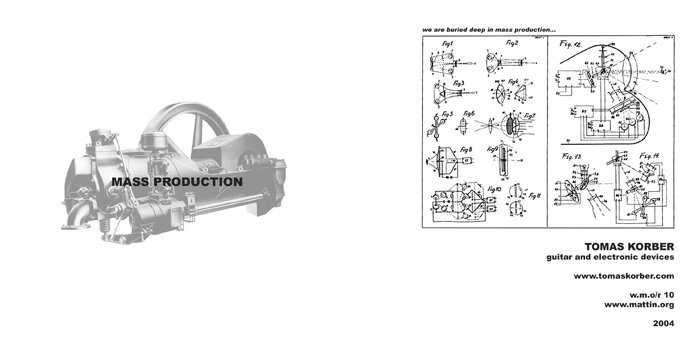
if at all, my impressions shift. Korber calls his fine, new disc “Mass
Production” and includes images and schematics of some old factory
equipment
so there’s already some possible attached meaning, a meaning that
would
appear to be enhanced by what you first hear, a gradual fade-in of some
irregularly rhythmic, mechanical seeming sounds, giving one a sonic image
of
a large rotor or fan, old and dirty enough to have acquired detritus that
clips its enclosure as it rotates. It’s slowly superceded by a more
generalized hum, a rich though non-tonal drone that contains more strands
than immediately apparent. Both of these elements are the sort of thing
one
might, if lucky, discover for oneself while wondering through an industrial
area. Whether you’d be aurally aware enough to stop and listen is
another
matter, hence the great value of a disc such as this. These episodes ebb
and
flow, again giving the impression of walking through a large space, turning
a corner that blocks out the previous drone only to open upon some machines
emitting a banshee wail.
In any event, this is the impression I get over the first 20 or so minutes.
Perhaps I’m being overly imagistic and Tomas may have different
ideas!
Suddenly, however, “Mass Production” makes a sharp right turn,
leaves the
factory entirely and enters, well, maybe an adjacent laboratory where
specialized experiments involving high frequency modulations are being
undertaken. Something goes awry and the technicians get the opposite of
what
they sought as the apparatus does an abrupt flip-flop into chasmic throbs
that threaten the integrity of the surrounding walls. More to the point,
this disjuncture is an attractive strategy, a way of not getting too caught
up in the relative luxury of the drones and rhythms, forcing one to step
in
a different direction at the risk of losing some overall coherence. I
suppose the critical thing is that you feel that the step was a natural
(if
entirely unanticipated) one, not taken because of a dearth of ideas but
more
so as not to allow one to get into any kind of rut, however enticing.
This
second section evolves and mutates until we arrive at a luscious pairing
of
high, rustling swizzles and a simple, basso hum that begins to ooze out
into
the space, losing solid shape and sublimating into the “room”
in a lengthy,
relaxed coda (I’m trying not to make my usual referent but at this
point in
the disc, it’s tough!). The pacing is wonderful; Korber knows when
to linger
and when to move on. He actually ends on a rather dramatic note, a swift
upswing in volume and sudden silence.
“Mass Production”—it’s a good thing.
Vital Weekly (The Netherlands),
number 425. Review by Frans de Waard
Swiss guitarist Tomas Korber is one of the upcoming names in improvised,
electronic music. He has done several collaborative works, such as with
Steinbruchel and Gunter Muller, but slowly has more and more solo recordings.
On this new CDR he plays, according to the cover, guitar and electronic
devices. As far I'm concerned it could have listed 'anything + electronic
devices', as this material sounds unlike a guitar and could be just any
sound source being fed through electronic devices. I don't mean this as
an critique, but as a compliment. Not that I hate the guitar but it's
always nice to hear the guitar being used in a totally alienated way.
And that's exactely what Korber does. In this single piece of three-quarters
of an hour he shifts through a whole bunch of electronic textures, ranging
from static hiss to the processed hum of motors on the guitar. Korber
plays here a minimal card, that only occassionally leaps into noisy patterns,
but for the bigger part is about ambient textures, although not necessarily
appealling to the real ambient crowd. In his approach he sounds like a
very early Jim O'Rourke and that's surely not the worst thing to be compared
with
Reviewed
by: Ed Howard
Reviewed on: 2004-06-16
This is shaping up
to be a fertile year for guitarist Tomas Korber. His clear melodic strumming
and judicious blending of electronics on the sublime recent disc Brackwater—a
quartet with improv “superstars” Otomo Yoshihide, Toshimaru
Nakamura, and ErikM—was among that album’s greatest assets.
Now, with a 3” on the way from Jason Talbot’s Kissy label,
Korber has unleashed his first full-length solo on Mattin’s W.M.O.
Mass Production won’t be much of a surprise to those who have already
heard Korber in a group context, though there’s none of the un-augmented
guitar that he used sporadically on Brackwater. Instead, this disc features
some of Korber’s most eerily beautiful electronics work.
The album opens with some scrabbling electronic noises like marbles rolling
over a bumpy surface; sounding similar to Tetuzi Akiyama’s guitar
deconstruction epic Resophonie. The music slowly builds tension as a low
drone hangs in the background, and as the solidness of the drone begins
to take hold, it sounds like the pointillist rattles and croaks in the
foreground are scratching holes in the surface of the drone. It’s
clear which is going to win out in the end, though, and over the course
of the next few minutes the drone slowly gains prominence, with the ratcheting
electronics not so much fading out as being swallowed up by the overflowing
abundance of thick droning sound, an “OM” tone that swells
briefly into all-encompassing prominence, and then itself fades away to
lull in the background.
As this drone fades away, Korber’s electronics unexpectedly take
on a more sinister cast, the sharp blasts of distortion and cranking static
riffs veering far closer to straight-up noise than the electro-acoustic
scene he’s usually been associated with. But deep within the chaos,
there are hints (imagined?) of ghostly guitar, a subliminal echo so subdued
and hidden by the noise that’s it easy to dismiss it as a mere spectral
figment, summoned by the knowledge that this is an album by a guitarist,
and so somewhere in there must be guitar. Imagined or not, this haunting
element gives some indication of the depth of Korber’s electronic
constructions. Within each gritty soundscape, and there are a whole succession
of them as this single 45-minute piece moves seamlessly from one section
to the next—there lurks a whole universe of detail, long sustained
tones interacting with earthier scrapes and buzzes that sound like heavily
processed guitar accidents.
Mass Production is a self-assured and fascinating new work from this very
promising musician. The serial nature of the piece precludes linear development,
as each new segment seems to emerge spontaneously just as the last part
is dying out, but this method of development allows the album to retain
a continual air of wonder and surprise, as each new shift inevitably veers
into totally new territory. Whether he’s working at bludgeoning
noise, or a hazy gauze of high-pitched electronics, or a thick soup of
sizzling raw circuits, Korber proves again and again on this album that
he has a wide musical vocabulary, and he’s equally adept all over
this tremendous range.
Touching Extremes (Italy)
reviewed by Massimo Ricci. June 2004
TOMAS KORBER - Mass production (w.m.o/r)
The way Korber gets unusual sounds from his electronically modified guitar
is probably the next step to the impossibility of recognizing a source,
which seems to be an interesting challenge for most adventurous experimentalists
in these days. Going from motorized mechanisms soliciting the strings
up to feedback modulations and ear-pinching, almost inaudible frequencies
slowly conducting the listener in a splendid finale with a low-droning
time capsule, Tomas throws the coordinates for a post-Keith Rowe new direction
of elemental guitar dismemberment, all the way to a new definition of
listening without being surcharged - instead riding on the basic properties
of the chosen matter